
Siirry suoraan sisältöön To homepage

Erik Bruun – a beloved artist

Kaksi kuvaa harmaahiuksisesta miehestä. vasemmanpuolisessa kuvassa hän piirtää työpöytänsä ääressä ja oikaenpuolisessa katsoo suoraan kameraan hymyillen.

Erik Bruun was born on 7 April 1926 in the village of Säiniö in Viipuri. He was the youngest of two siblings, his brother, Kaj, being some three years older. The Bruun family had a chicken farm, which his mother managed, while his father ran a feed and seed business.

The family boasted accomplished drawers even before Erik. According to Erik Bruun, his maternal grandfather, a land surveyor, produced beautiful hand-drawn maps and unknowingly influenced Erik’s choice of profession, passing down his gift for drawing to his grandson. During his childhood, Erik also developed a love for nature, especially birds. The deep boom of the great bittern, heard across Lake Äyräpäänjärvi on summer nights, made an indelible impression on Bruun.
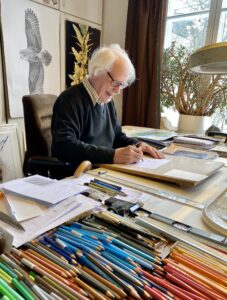
Harmaahiuksinen mies piirtämässä työpöydän ääressä.

Erik Bruun in his studio. Image: Peter Bruun.


Early life and career

After the war, the family moved to Espoo, where they established a family-run market garden, Bruunkulla. Erik Bruun began his studies at the School of Applied Arts, while also working as a commercial artist. He graduated from the Department of Graphic Design in 1949. A wide range of employers and his work as a freelance graphic designer offered up a variety of subjects, but Finland’s nature has always held a special place in his work.

Erik Bruun is best known as a poster designer and for his work in advertising. His precise lines and vivid colours also make for ideal postage stamp designs.

A good street poster must also work at the size of a matchbox. Looking at a matchbox at arm’s length, the viewing angle is roughly equivalent to glancing at a street poster from a car window. The viewer should be able to understand the idea within seconds. The same principle applies to designing stamps.

Bruun designed banknotes at the Bank of Finland’s printing works (Setelipaino), which eventually led him to designing stamps. After leaving the printing works, he has proactively proposed subjects for stamps, most of which have ultimately been issued.


Erik Bruun as a stamp designer

The majority of Erik Bruun’s stamps depict nature and Finland’s UNESCO World Heritage Sites. His stamps render precisely such details as birds’ plumages and the individual features and overall character of World Heritage Sites. During his time living in one such World Heritage Site, the Suomenlinna sea fortress in Helsinki, Bruun’s stamps were inspired by birds that lived on and flew over the islands.

Bruun begins the process of designing stamps by sketching at the stamp’s final size, allowing him to see immediately how a subject will work in practice. For printing, the original drawing is enlarged to five times its original size.

Bruun has taken stamp design seriously; he aims for his subjects to resonate with viewers. More than 50 stamps designed by Bruun were issued between 1986 and 2019.


Erik Bruun – 100 years in 2026

Erik Bruun turned 100 on 7 April 2026, and to mark the occasion, Posti issued a stamp sheet based on his classic poster designs. It features the Crayfish Season poster (1958), which promoted tourism in Finland, the Jaffa outdoor advertising poster (1959), the iconic Saimaa Ringed Seal poster (1974), the Mushrooms in August poster from the Forest Finland series (1996) and the self-published Pinecone poster (2005).
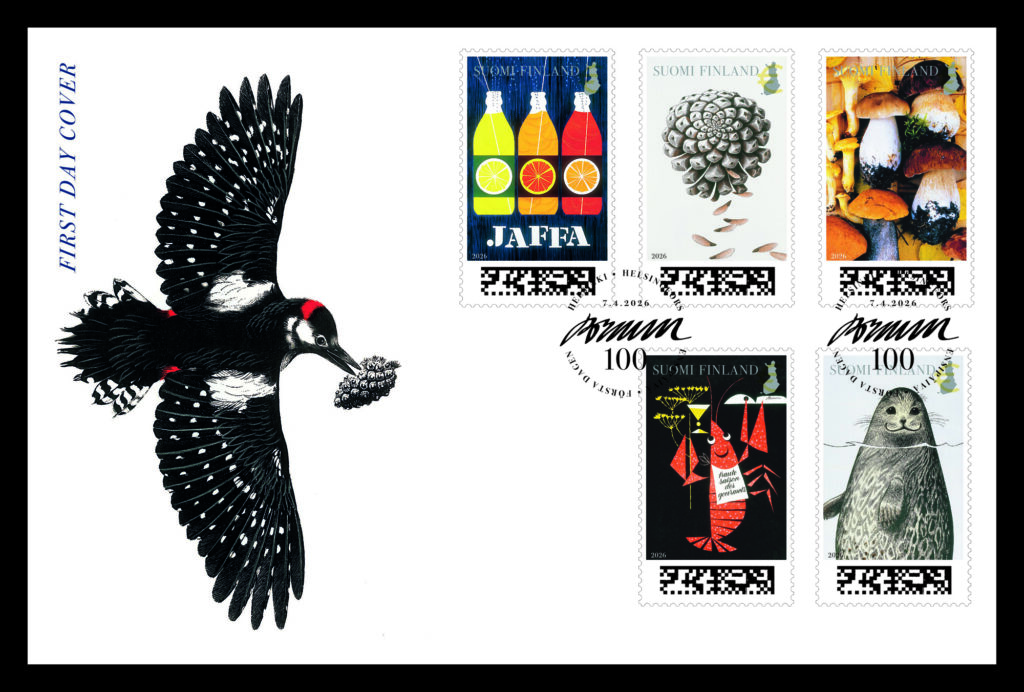
Kirjekuorella on viisi värikästä postimerkkiä, postileimoja ja kuoren vasemmassa laidassa piirretty tikka kantaa käpyä.

Ilkka Kärkkäinen was responsible for the graphic design of the Erik Bruun 100 years sheet and first day cover.


Content:

The illustration for the first Finnish postal letter, issued in 1981, was designed by Erik Bruun. Pastel, pencil and ink on card.

Erik Bruun’s first designs for Posti

Bruun’s first works for Posti were illustrations for postal letters in the early 1980s. A postal letter was a type of pre-paid postal stationery: senders would write a message on the sheet, which, once folded, became an envelope. Postal letters were issued from 1981 to 1999.

The first postal letter, dated 1981. The message was written on the back of the paper.

The illustration for the 1983 postal letter was a bird’s feather secured with a seal. Pastel and pencil on card, with details in ink on film.

Concept sketch and sheet design: Erik Bruun. Covers: Torsten Ekström. Pirkko Vahtero made two drawings for printing.

Bruun took his first steps in stamp design with the Centenary of Finnish bank note printing stamp book in 1985. He created the stamp sheet in collaboration with other artists at the Bank of Finland’s printing works.

A first day cover is issued on the day a stamp is released and is often designed by the stamp designer. The stamps, cover illustration and first day of issue postmark repeat the same theme.

Bruun’s stamps feature a wide range of subjects

Bruun’s next stamp designs depicted butterflies. The Orange-tip, Apollo and Camberwell beauty stamps were issued in 1986.

The tourism-themed Seurasaari Open-Air Museum and Saimaa stamps followed in 1991, a joint project organised by the Nordic Postal Union.991.

Concept sketch for the Vyborg Castle 700 years stamp. Pencil, colour pencil and ink on paper.

Designing the stamp for the 700th anniversary of Vyborg Castle was particularly meaningful for Bruun. Beneath the castle, at the foot of the stamp, appear the words ‘Suomi Finland’. This country designation is printed on every stamp, but in this case the words held special significance:

Vyborg Castle celebrated its 700th anniversary in 1993. I proposed a design showing a postal route drawn across the sky from Turku through Helsinki, Porvoo, Loviisa and Vyborg to St Petersburg. Russians were asked if they wanted to participate, but they declined, saying that they were working on other projects. Vyborg Castle with the words Suomi – Finland printed under it. I should mention here that St Petersburg was only 350 years old.

The concept sketch for the Water birds was completed in 1989. Colour pencil, pencil and ink on paper.

Erik Bruun’s birds and forest

A series of bird-themed stamp sheets was first introduced in 1993 with the Water birds stamp book. Black-throated loons, a goosander, a red-breasted merganser and a mallard couple are immortalised in a lakescape tinted in hues of blue.

The book of water bird stamps was designed on the shores of a lake in the wilds of Loppi, where you can hear the call of the black-throated loon every evening in the early summer. I’m not the only one who likes it – the public voted A flock of black-throated loons the most beautiful stamp that year.

The profile of a red-breasted merganser appears on the cover of the Water birds stamp book. Ink on paper.
Forests and forest research stamp book sketches Birch, Pine, Spruce and Research. Pencil, colour pencil and watercolour on paper.

Forests and trees are an important part of Finland’s natural environment, as well as a great source of inspiration for Erik Bruun. The XX World Congress of the International Union of Forest Research Organizations IUFRO was held in Tampere from 6 to 12 August 1995, and a four-stamp book designed by Bruun was issued to mark the occasion. The stamps depict the blossoms of trees from Finnish forest in fine detail.

First day covers for Cranes and Waders. The postmarks and cover designs were also by Erik Bruun.

The Waders miniature sheet (1996) continued the series of bird-themed stamps, with the idea coming from Bruun himself. The sheet was printed using offset-print in conjunction with line engraving, a rare technique by the 1990s. The series continued in 1997 with the Cranes miniature sheet.

Concept sketch for the Christmas stamp series. Pencil, colour pencil and ink on paper.

Christmas stamps by Erik Bruun

Erik Bruun designed the 1997 Christmas stamps. His first concept sketch was issued in a slightly modified form. His proposals for the subjects were St John’s Church in Helsinki, Turku Cathedral, a village at Christmas and a candelabrum in a church. Turku Cathedral was omitted from the final series.

St John’s Church, approved sketch. Colour pencil and ink on paper and film.
First day cover for the 1997 Christmas stamps.
Snowy Owl sketch for the first day cover. Greyscale pencil on paper.

Series of bird-themed stamps continues

The Owls miniature sheet features a Eurasian eagle-owl, a boreal owl, a great grey owl and a snowy owl. The first day cover features a snowy owl in flight.

I drew this snowy owl because it is such a magnificent bird. If it cannot find sufficient food in Lapland, it may fly as far as Suomenlinna in Helsinki, as happened in the 1980s. I borrowed a snowy owl’s wing from the Natural History Museum so that I could draw the bird as seen from above.

Sketch for the Owls miniature sheet on transparent sketch paper.

The owl is a symbol of wisdom, so it’s quite suitable as a motif for a postage stamp, a small face value voucher.

Sketch for the Great bittern stamp. Ink on silk paper.

The Summer night birds sheet features the great bittern, one source of Erik Bruun’s childhood love of birds. Bruun has immortalised this bird in posters and stamps; it is rarely seen in nature as a result of its skill at hiding.

In spring and autumn, the migration routes of millions of birds crossed the Karelian Isthmus. My father also often took us to Lake Äyräpäänjärvi, where many rare birds nested. Birds are enchanting to watch.

Sketch for the Summer night birds miniature sheet. Black ink highlights on film.

The sheet features a cuckoo, corncrake, European nightjar and thrush nightingale in addition to the great bittern.

This idea came to me one night. You can hear the call of these birds at nighttime in Finland if you happen to be in the right place.

Sketch for the Suomenlinna stamp. Colour pencil on paper, with ink highlights on transparent sketch paper. The layers are taped together.

Suomenlinna – Home and a source of inspiration

There are two stamp issues that feature the Suomenlinna sea fortress, the first, issued in 2000, was based on a poster jointly designed by Erik and Sinikka Bruun in 1968.

Sketch for the Suomenlinna – Sveaborg sheet. Colour pencil on paper, with ink highlights on film.

The second was Sveaborg – Suomenlinna, produced in collaboration with Sweden Posten in 2006, which featured sailing ships in front of the fortress. The King’s Gate in Suomenlinna also features on one of the stamps in the 2014 Old castles sheet.

Sketches for the first day cover of the Verla Groundwood and Board Mill miniature sheet.

UNESCO World Heritage Sites immortalised by Erik Bruunt

Seven stamp sheets designed by Erik Bruun were issued in the six years between the two Suomenlinna sheets. Their subjects included birds, UNESCO World Heritage Sites and a bear cub.
The Verla Groundwood and Board Mill (2001), Old Rauma (2002), Sammallahdenmäki Bronze Age Burial Site (2004) and Petäjävesi Old Church (2005) all depict UNESCO World Heritage sites, with a miniature sheet designed by Erik Bruun commissioned for each of them.

The UNESCO World Heritage Sites were to each be commemorated on a stamp. Verla is the old board mill of my former client, Kymi. Although it ceased operations long ago, in 1964, it was wisely preserved as a museum factory.

Concept sketch for the Old Rauma stamp sheet. Pencil, colour pencil and ink on paper.

Old Rauma was added to the UNESCO World Heritage List in 1991. I explored the maritime town and marvelled at how ornate the houses of the seafaring people were.

The Sammallahdenmäki sheet that was issued only contains two stamps, but its overall character closely resembles Bruun’s first proposal.

I visited the site to see Sammallahdenmäki for myself. The cairns were built on the cliffs 2,000–3,000 years ago. Due to land uplift, they now stand on a hill that is 30 metres high. The upper part of the sheet depicts the past landscape. The stamps show stones decorated with lichen.

The Sammallahdenmäki first day cover captures every element of the site.
Petäjävesi Old Church. Concept sketch for the stamp sheet.

Petäjävesi Old Church was added to the UNESCO World Heritage List in 1994. It is a true attraction and a fine example of traditional carpentry skills. From now on, I want the site’s name to appear prominently on the sheet of stamps.

Sketch for the Woodpeckers sheet. It was made in three layers. Colours on paper below and black ink highlights on two film layers on top.

Block of flats for woodpeckers

The Woodpeckers stamp sheet was issued in 2001, only a month after the Verla Groundwood and Board Mill stamps. Like Bruun’s other bird-themed stamp sheets, the theme was his idea.

I included two trees on the woodpecker sheet: an aspen and a dead pine. Old dead trees are like blocks of flats for woodpeckers, home to many woodpeckers’ nests, often made by black woodpeckers. It is easier to peck a nest cavity into an old aspen.

Approved sketch for the Swan stamp.

National symbols

Finland’s national bird, the whooper swan, has appeared on several stamps, and Erik Bruun designed three of them across two issues. Finland’s national animal, the bear, appears as a smiling cub on a stamp designed by Bruun in 2004.

Bruun’s first design themed on the swan was issued in 2002 and features a whooper swan in flight.

A sketch for the Swan sheet’s background pattern.
Sketches for the Whooper Swan stamps. Pencil, colour pencil and ink on paper.

Erik Bruun continued creating art well into his nineties. His most recent stamp sheet, Whooper Swan, comprising two different stamps, was issued in 2019, when he was 93.

The swan is an awe-inspiring animal. A swan couple live together for a long time and take loving care of their chicks. I used to observe swans and other water birds keenly in Lake Inari, and I have great respect for them.
I wanted one of the stamps to show what a whopper swan does with its long neck as it tears water plants from the bottom of the lake with its strong beak.

The Bear Cub first day cover is illustrated on both sides.

The bear cub’s playful smile resembles Erik Bruun’s familiar classic, Saimaa Ringed Seal (1974), which later became the emblem of the Finnish Association for Nature Conservation. Bruun designed forest-themed illustrations and beautiful bear paw prints for the postmark on the Bear Cub first day cover.

Olavinlinna Castle

Finland’s historic castles beautifully depicted on stamps

Bruun’s drawings of the six best-known Finnish castles, almost photographic in their detail, offer impressive evidence of his masterly skills as an artist. The images are from the approved sketches. Pencil, colour pencil and ink on paper.

Raseborg Castle
Häme Castle
Turku Castle
Suomenlinna
Kastelholm Castle
Concept sketch for Bird Feathers, featuring feathers of a swan, pheasant, grey partridge, jay, waxwing and woodpecker.

The Bird Feathers sketch and the Feather stampi

When drawing birds’ feathers, plumage and animals, Erik Bruun has used both living animals and specimens from the collections of natural history museums as his models. For example, Bruun drew the Saimaa ringed seal from a living model at Särkänniemi Aquarium. According to Bruun, the seal smiled when it saw the finished drawing.

As references for plumage, he used loose feathers shed by mallards that he fed in his garden as well as dead birds.
The Bird Feathers proposal was not approved, but one feather drawing from the series was issued as a stamp.

The idea for my stamp is based on a tradition dating back more than a hundred years. A feather was attached to the corner of the envelope of a letter with sealing wax to mark it as express mail.

Sketch for the Feather stamp.
Sketch for the Feather stamp's first day cover.
Sketch for the Chanterelle stamp.

A stamp sheet jointly created by several designers

The Edible Mushrooms stamp book features five edible mushrooms depicted by five designers. The Chanterelle stamp and the illustration of a mushroom basket on the booklet cover are by Erik Bruun.

Sketch for the cover of the Edible Mushrooms stamp book.
Sketches for the Arktika stamps: Goldeneye, Velvet Scoter, Brent Goose and Barnacle Goose.

Arctica

Of the three most recent stamp releases designed by Erik Bruun, two sheets are bird themed: Arctica and Whooper Swan, which is discussed in connection with the Swan stamp. The idea for the Arctica miniature sheet came to Bruun at his home in Suomenlinna:

I got the ideas for these stamps when large flocks of birds flew over Suomenlinna.

The quote is from a piece of paper found among the sketches for the stamps.

Sketch for the Vendace stamp.

Pikeperch and vendace

As a hobbyist fisherman, Erik Bruun had access to real specimens when drawing fish. The sketches for the Pikeperch and Vendace stamp sheet, with their silver highlights and scale-patterned sheet margins, are richly detailed.

Sketch for the Pikeperch stamp.
Sketches for the sheet margins.
A maximum card featuring the Saimaa Ringed Seal stamp from the Erik Bruun 100 Years stamp sheet issued on 7 April 2026. A maximum card features the same image or theme on the card, stamp and postmark. The stamp and postmark are placed on the picture side of the card.

Erik Bruun 100 years

The Postal Museum wishes this much-loved graphic artist very happy centenary celebrations and offers the warmest thanks for his collaboration.
Erik Bruun’s Birds exhibition at the Postal Museum’s collaborative space Kupla in Vapriikki proved extremely popular in early 2026. Many visitors were touched and inspired to draw birds themselves.

Feedback wall created during the Erik Bruun’s Birds exhibition.
Collected pieces of feedback and bird drawings by museum guests.
References

">

References

Read more

">

Read more

See all the stamp sketches designed by Erik Bruun and read more about the design process:

Erik Bruun on YLE Areena:

Takaisin ylös