Siirry suoraan sisältöön To homepage

Vilho Railo, Flower-themed collection

In Vilho Railo’s thematic collection stamps and covers are arranged by plant families. 61 exhibition sheets have been selected for browsing here: Roses (Rosaceae), Orchids (Orchidaceae) and Lilies (Liliaceae).

Roses , Orchids and Lilies

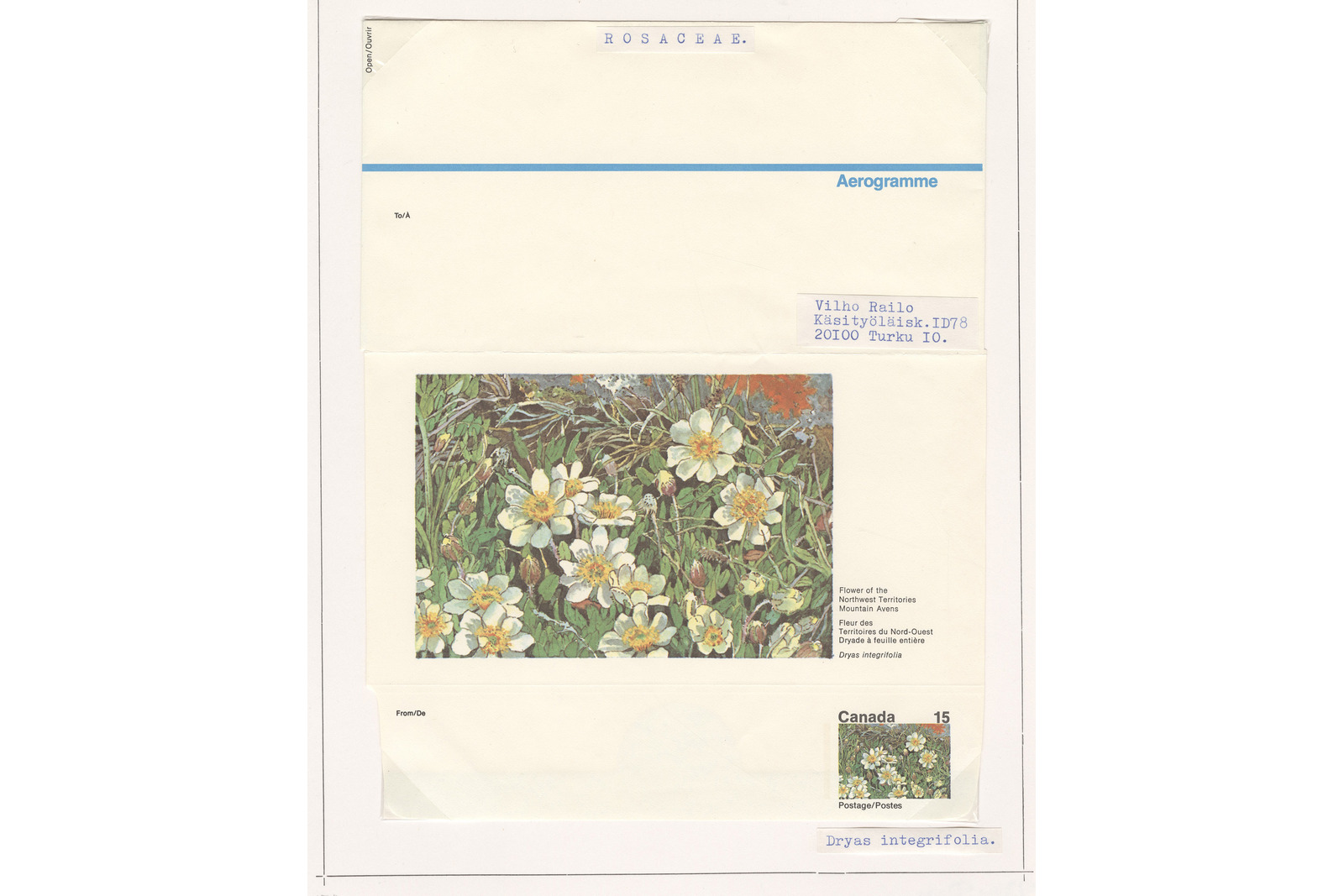
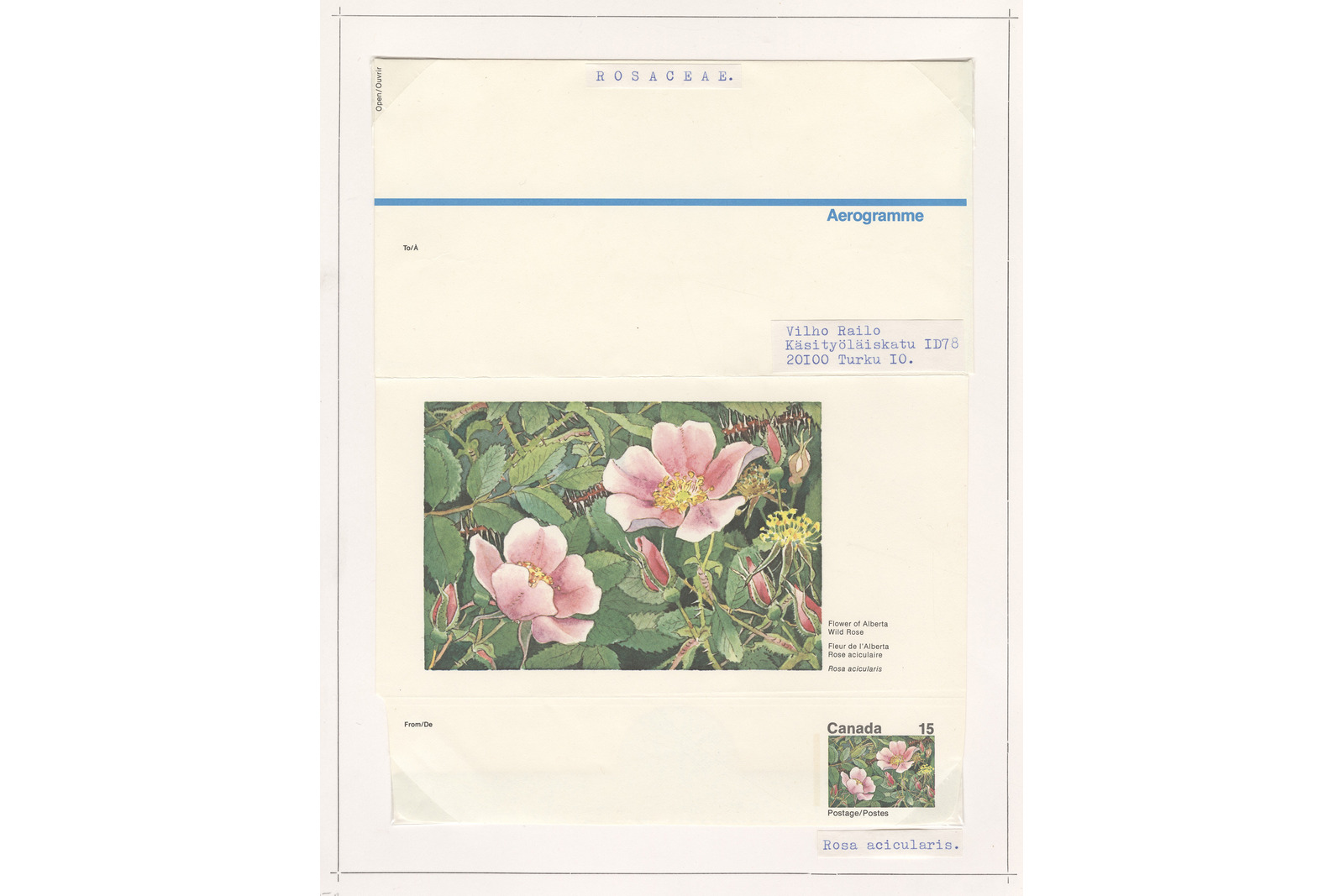
At the top is the heading "Rosachae," in the center is the address, and below that is a larger picture of a flower, with a smaller version of the same image in the lower right corner.
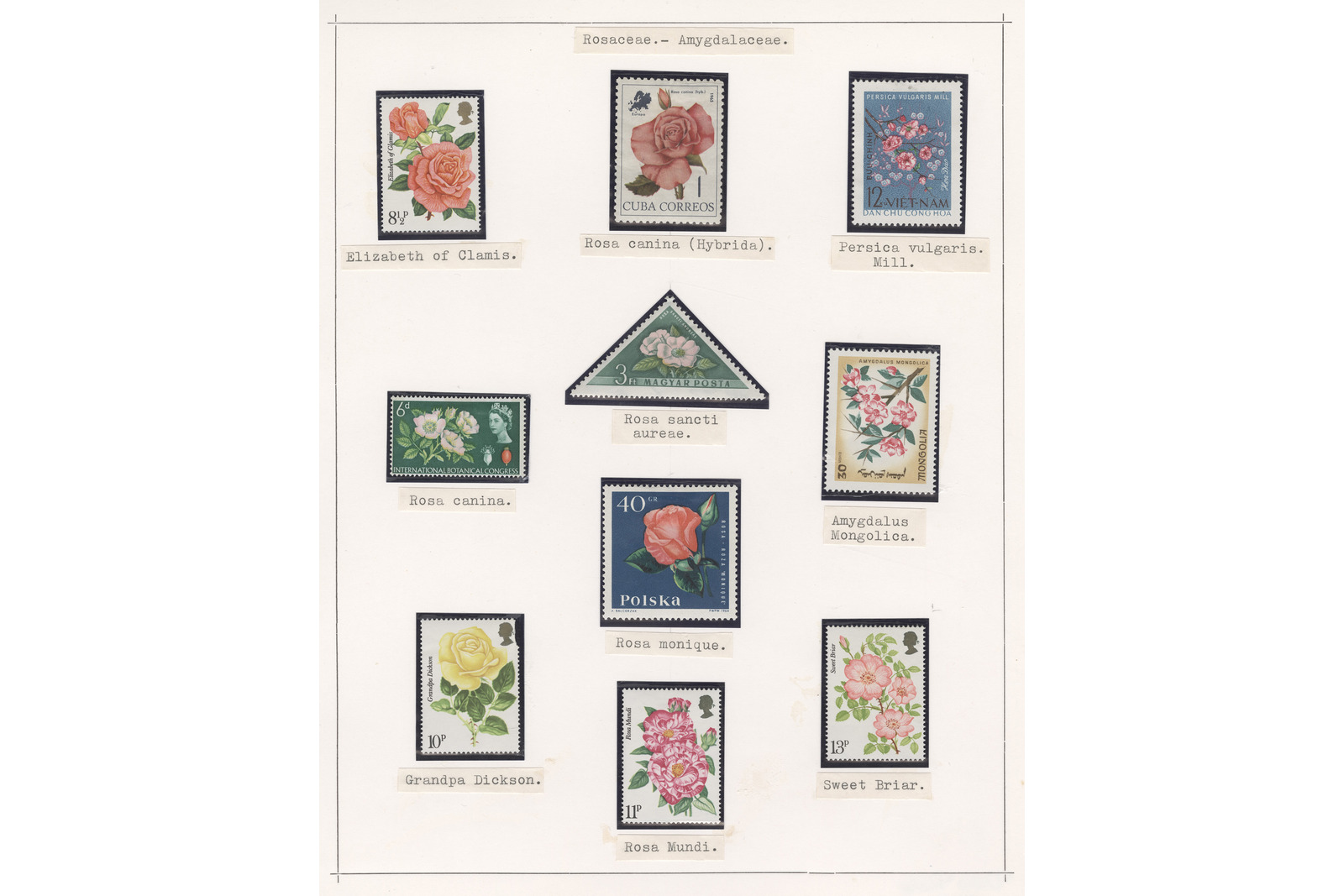
The page features ten different rose postage stamps, with their names in various languages listed below them.
The page features nine different rose postage stamps, with their names in Latin listed below them.
At the top of the page, under the heading "Rosaceae," there are six rose stamps, with their Latin names listed below them. At the bottom of the page is an envelope with a rose stamp in the upper right corner.
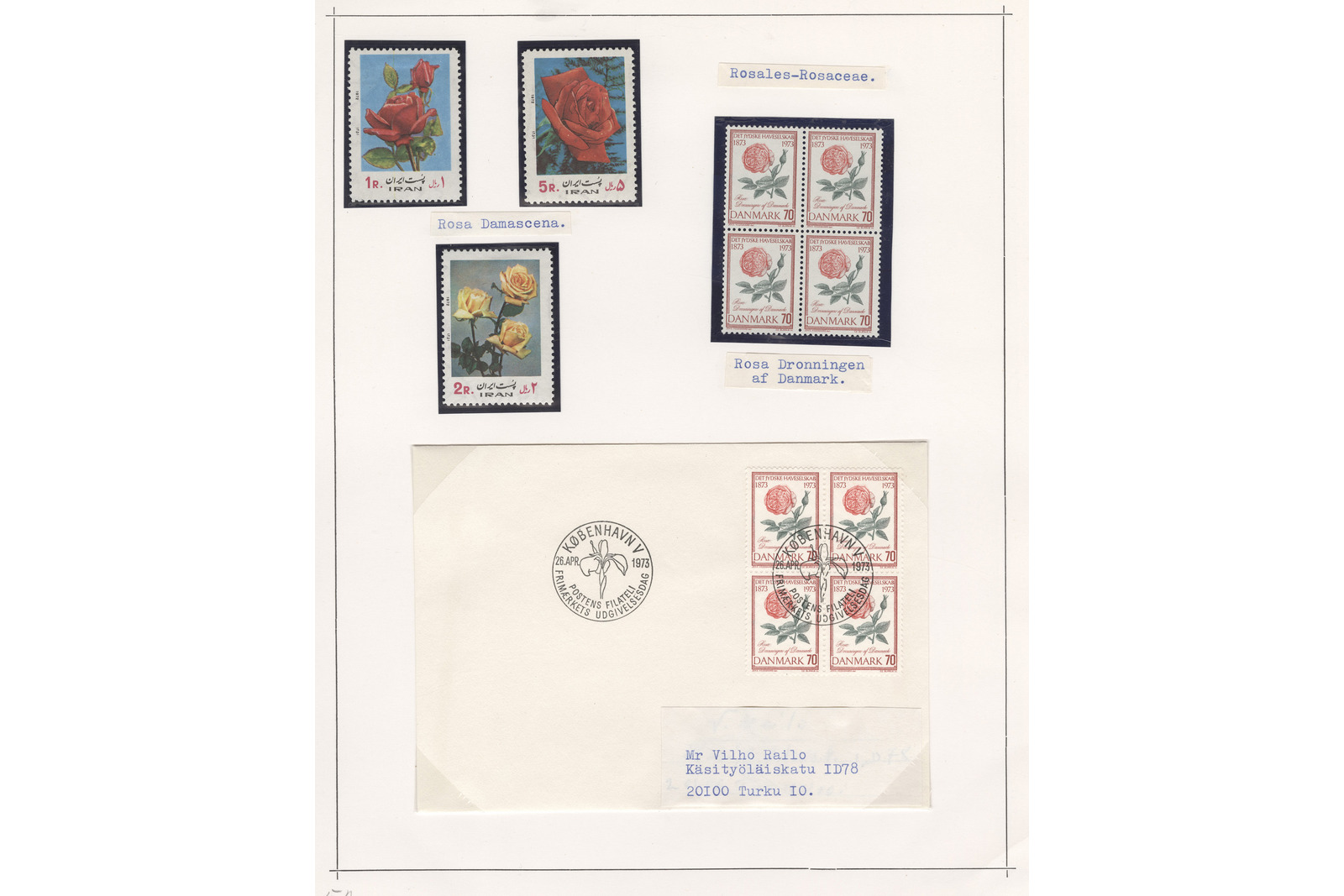
At the top of the page are three individual rose stamps, and to the right of them is a set of four stamps. At the bottom of the page is an envelope featuring a similar set of four stamps as the one at the top, in the upper right corner.
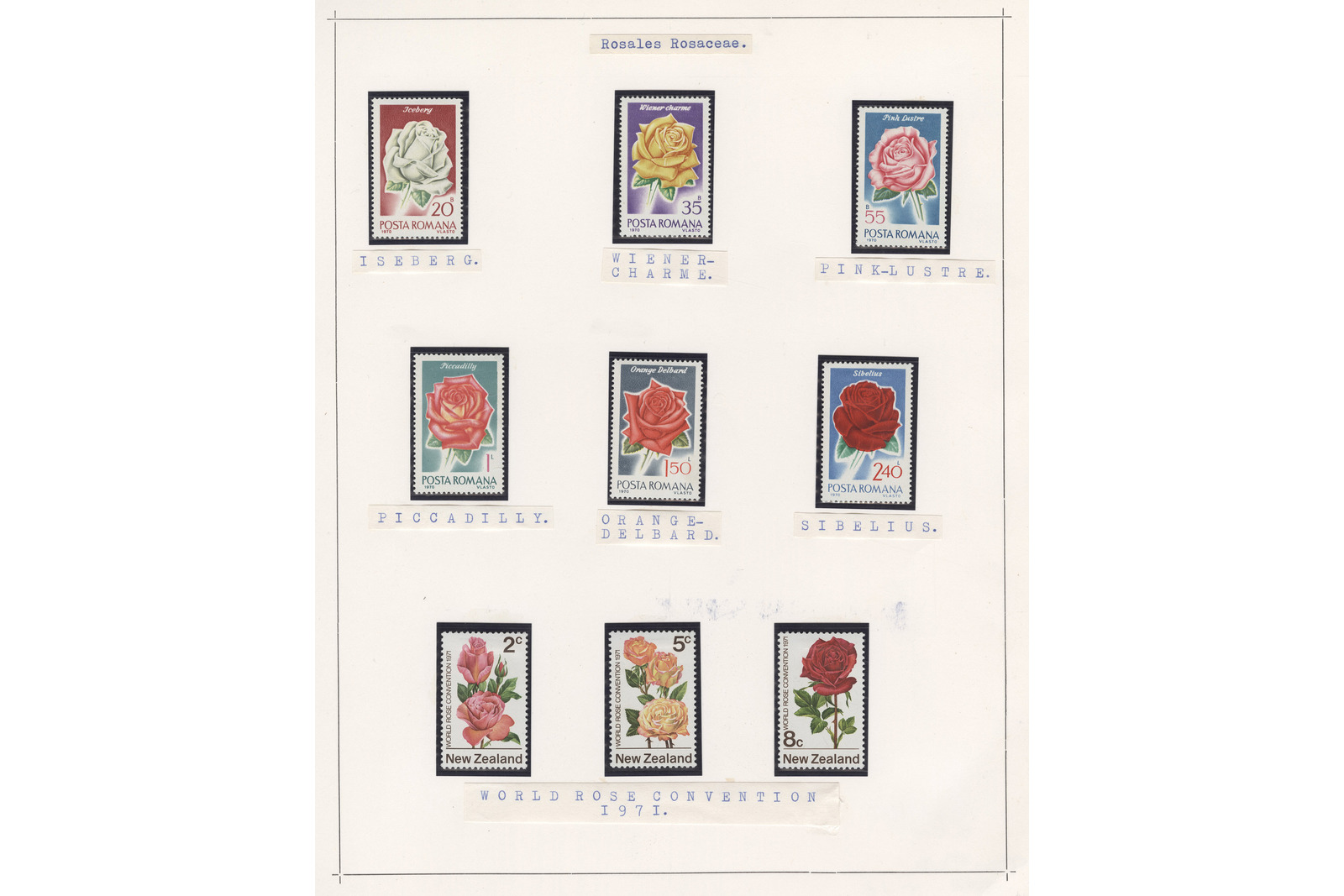
At the top of the page is the heading "Rosales Rosaceae." Below this are eight different rose stamps, with three in each of the first two rows and two in the last row.
At the top of the page is the heading "Rosales Rosaceae." Below this are nine different rose stamps, arranged in three per row. The Latin name is printed below each stamp.
At the top is the heading "Rosacheae," in the center is the address, and below that is a larger photo of a flower, with a smaller version of the same photo in the lower right corner.
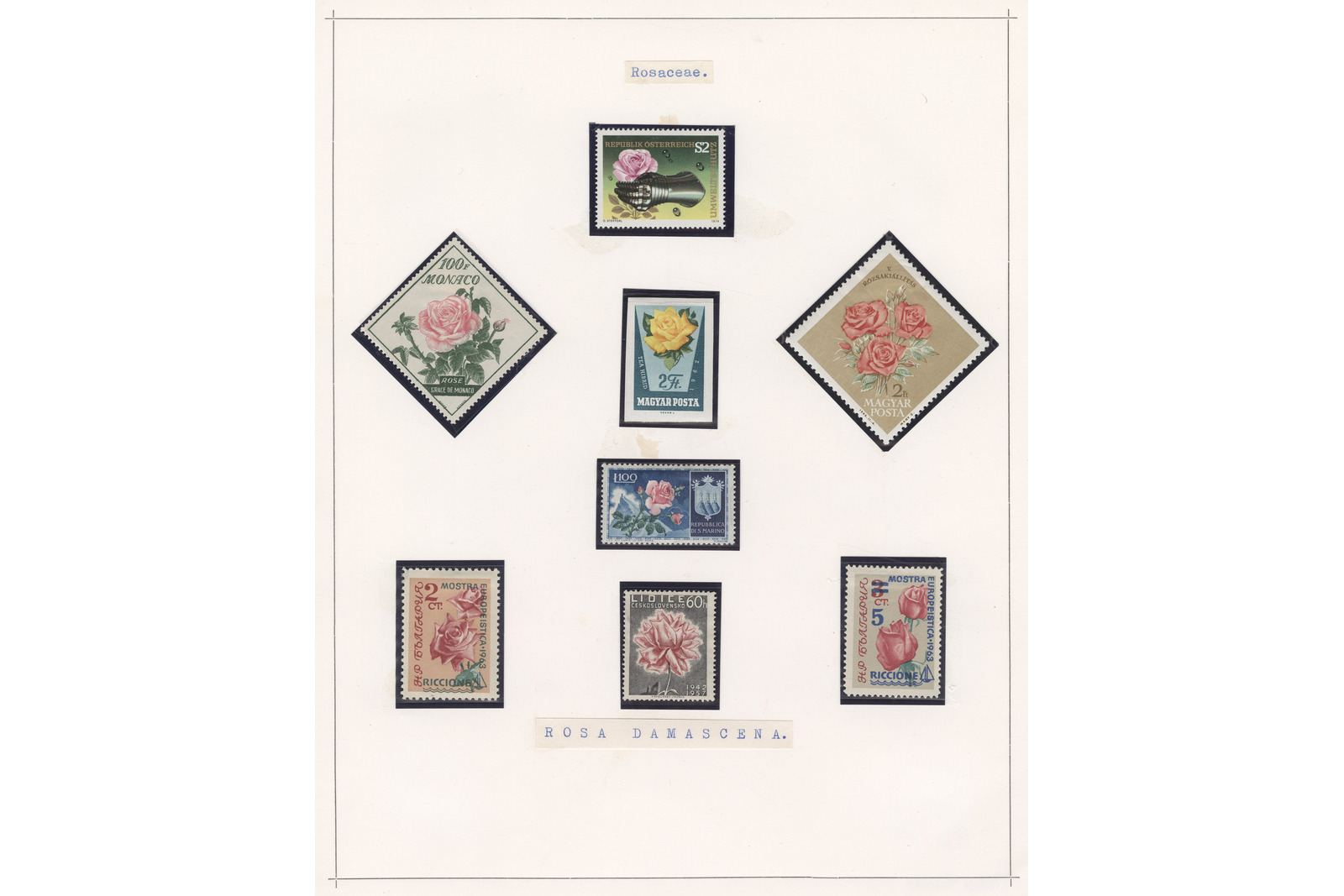
At the top of the page is the heading "Rosaceae." Below this are eight different rose stamps arranged as follows: one at the top, two in the middle—flanked by oblique-angled stamps—and three in the bottom row. Below them is the text "Rosa Danascena."
At the top of the page is the heading "Rosaceae." Below this is a circular pair of stamps featuring a woman’s profile and text. Below that is the heading “Rosa Pendulina. L.,” beneath which is an envelope bearing a Polish floral stamp and, in the upper left corner, a similar image of a woman.
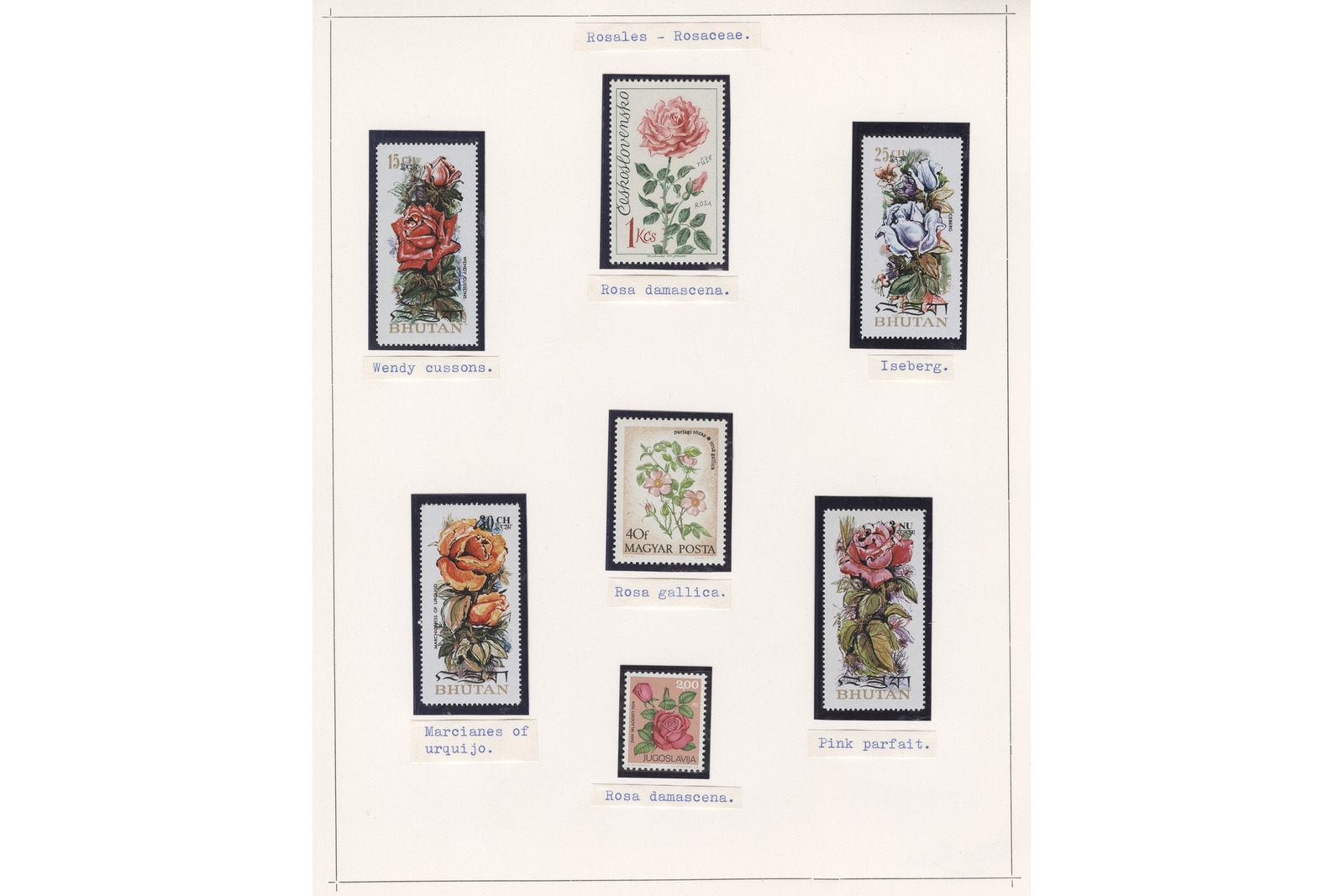
At the top of the page is the heading "Rosales Rosacese." Below this are seven different rose postage stamps, arranged in two rows of three and one in the last row. The name is written in Latin beneath each stamp.
At the top of the page is the heading "Rosaceae." Below this are seven different rose stamps arranged as follows: three in the first row, two on the outer edges of the bottom row, and two in the center. The Latin name is written below each stamp.
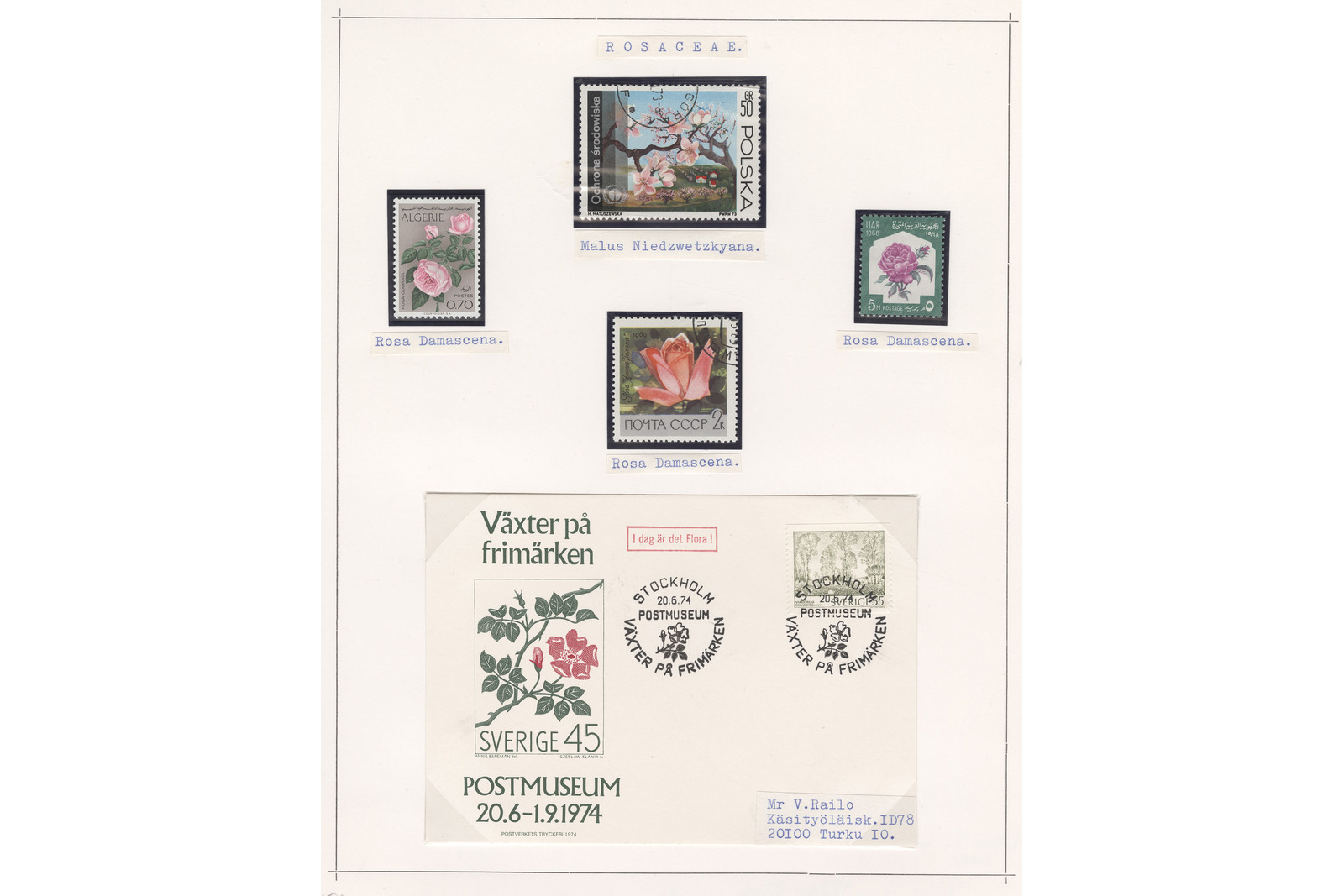
At the top of the page, under the heading "Rosaceae," there are four rose postage stamps, with their Latin names listed below them. At the bottom of the page is an envelope with an image of a rose postage stamp on the left. The text around it reads: "Växter på frimärken" (Plants on Postage Stamps), Postmuseum, June 20–September 1, 1974.
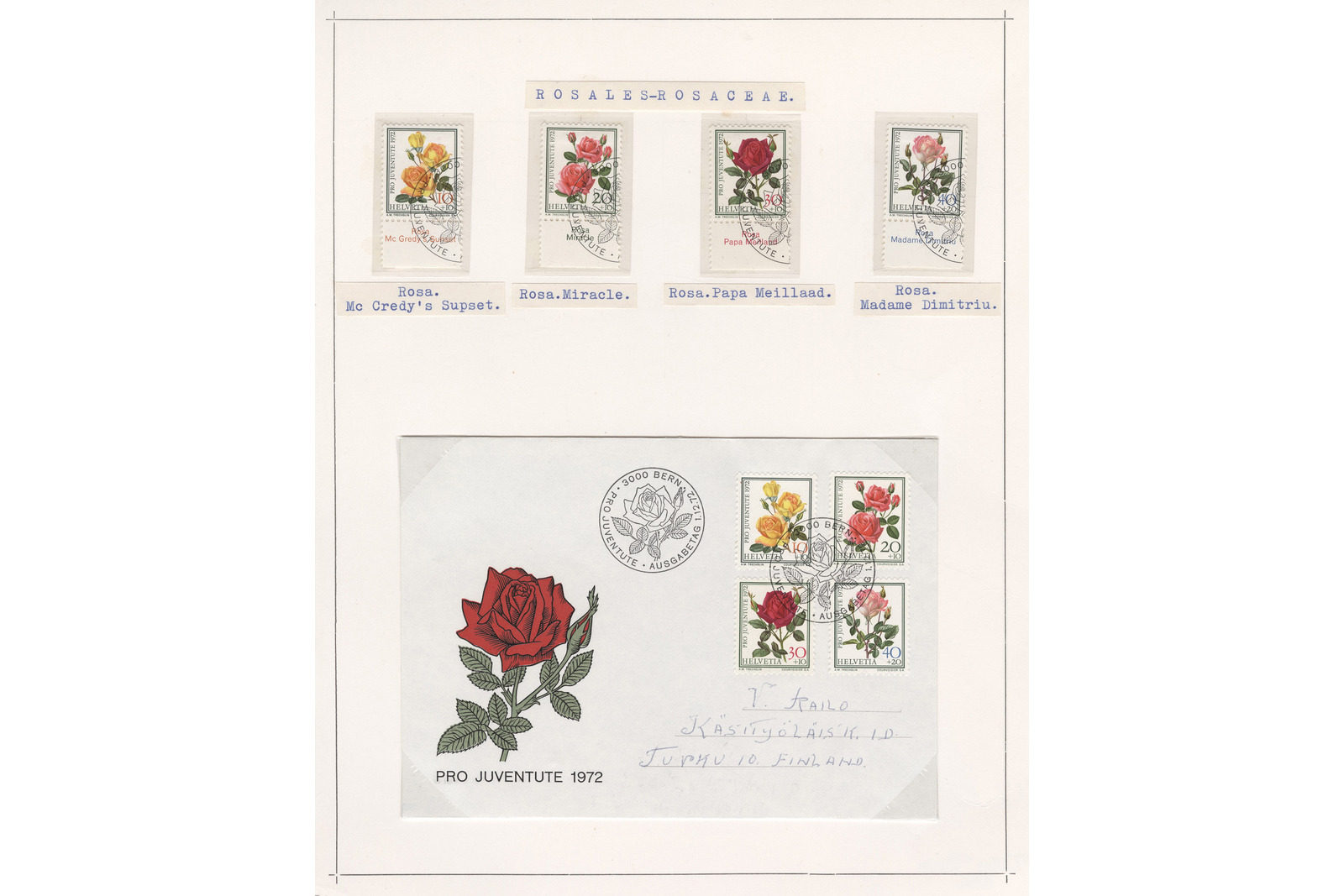
At the top of the page, under the heading "Rosales - Rosaceae," there are four rose stamps in a row, with their Latin names listed below them. At the bottom of the page is an envelope featuring the same four rose stamps arranged in a square pattern. The envelope features an illustration of a rose.
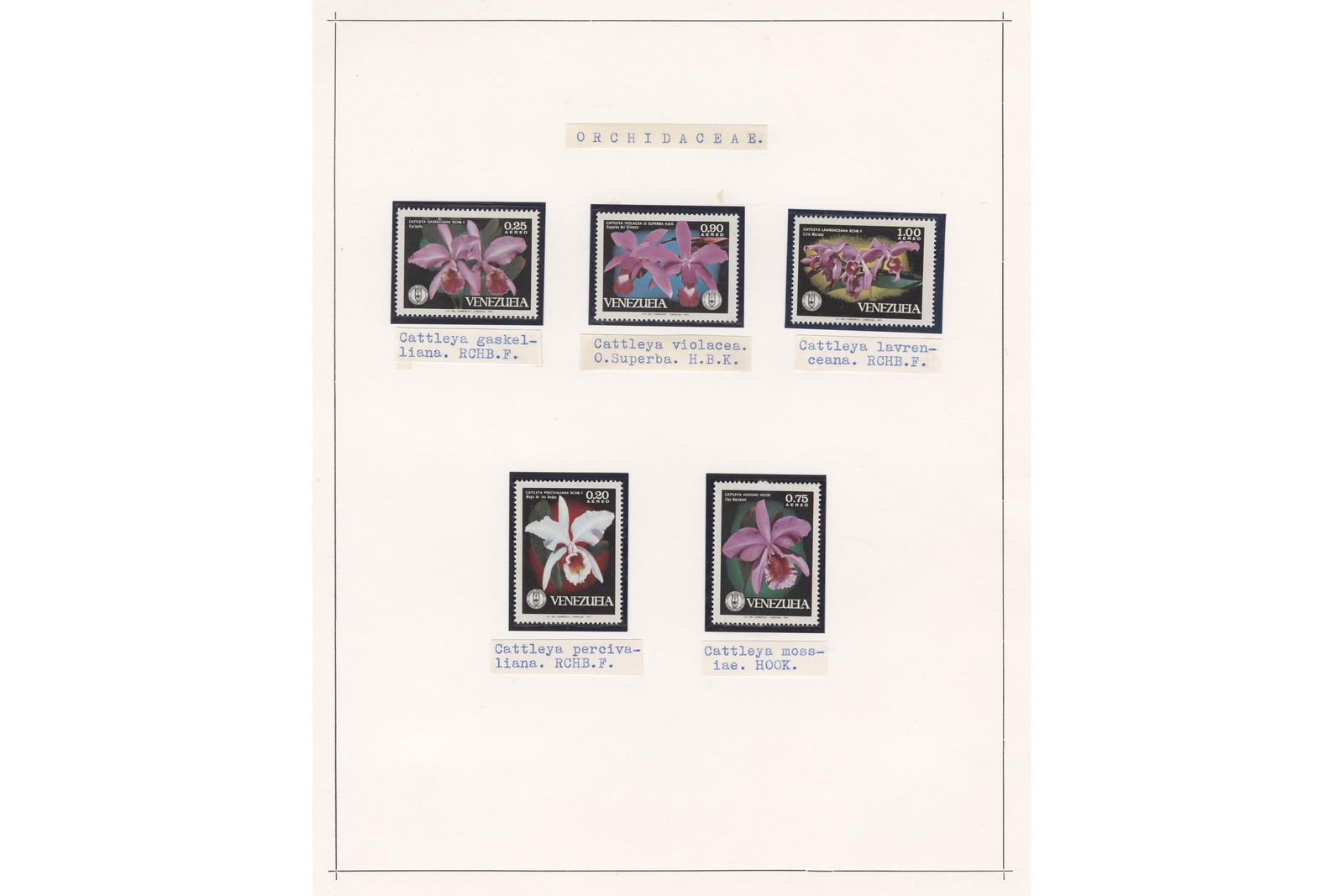
At the top of the page, under the heading "Orchidaceae," there are two rows of orchid stamps: the first row contains three horizontal stamps, and the second row contains two vertical stamps, with their Latin names listed below them.
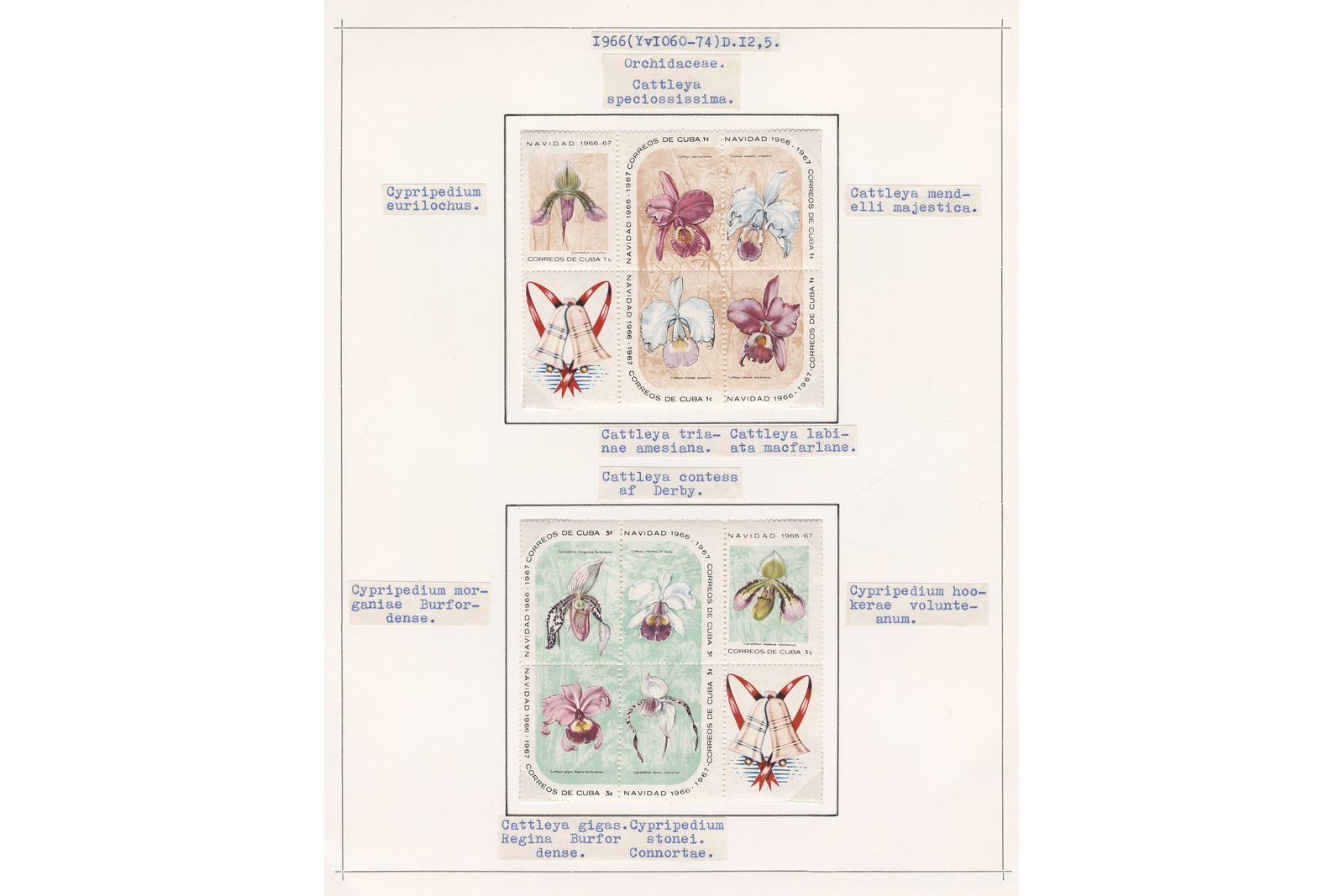
At the top of the page, under the heading 1962 (YvI060-74) D.I2.5, there is a series of postage stamps depicting orchids, with their Latin names surrounding them. Below that is the heading “1962 (Iv 533-36) Non Dent,” beneath which are two vertical sets of two stamps each. The Latin names appear below these.
At the top of the page, under the heading "1962 (YvI060-74) D.I2.5," there are two sets of stamps featuring orchids, with their Latin names surrounding them.
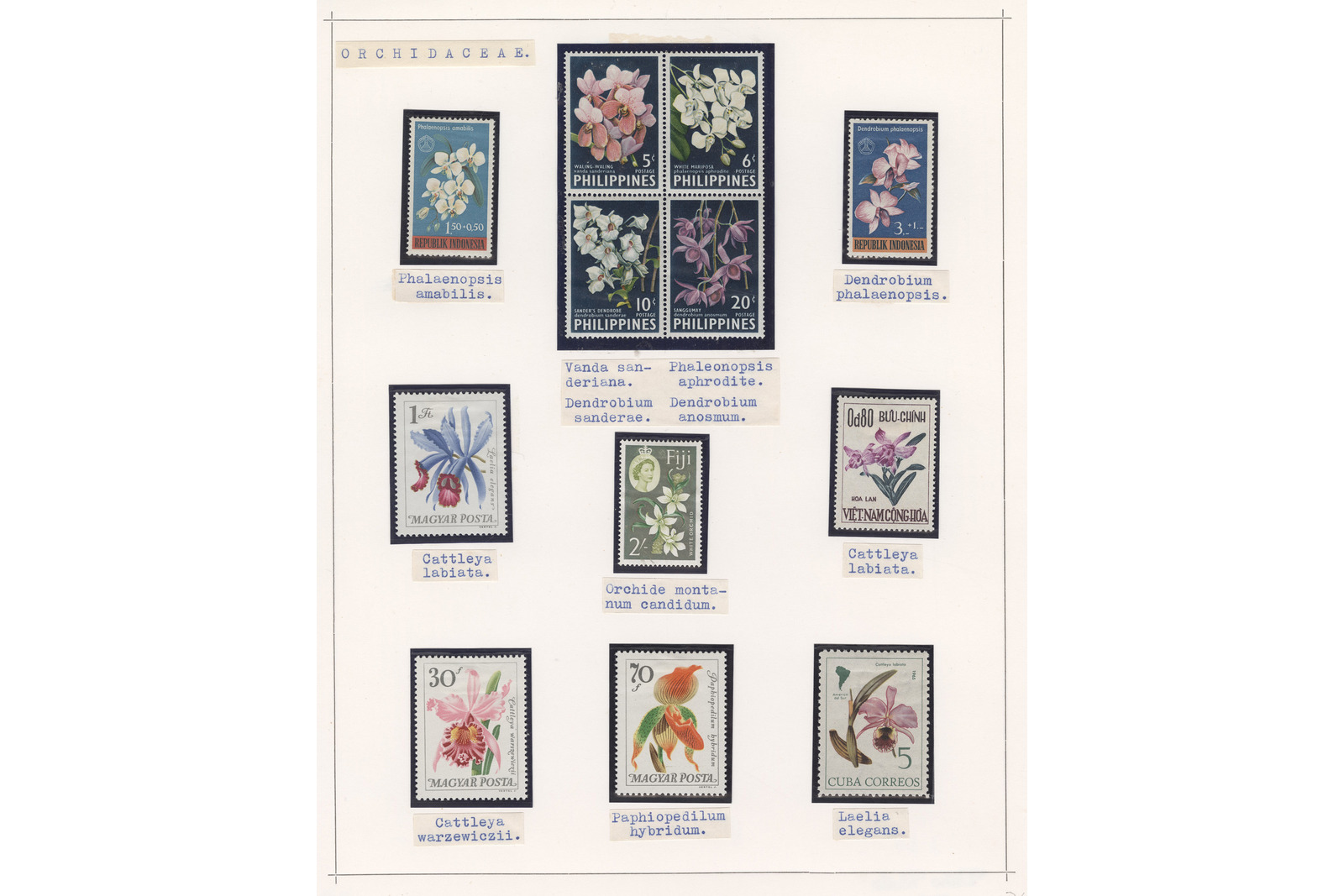
At the top of the page, under the heading "Orchidaceae" on the left, there are three orchid stamps arranged vertically, and on the right side of the page, there is a set of four stamps with two separate stamps below them. On the right-hand side, there are three separate orchid stamps arranged vertically. The Latin names are listed below each one.
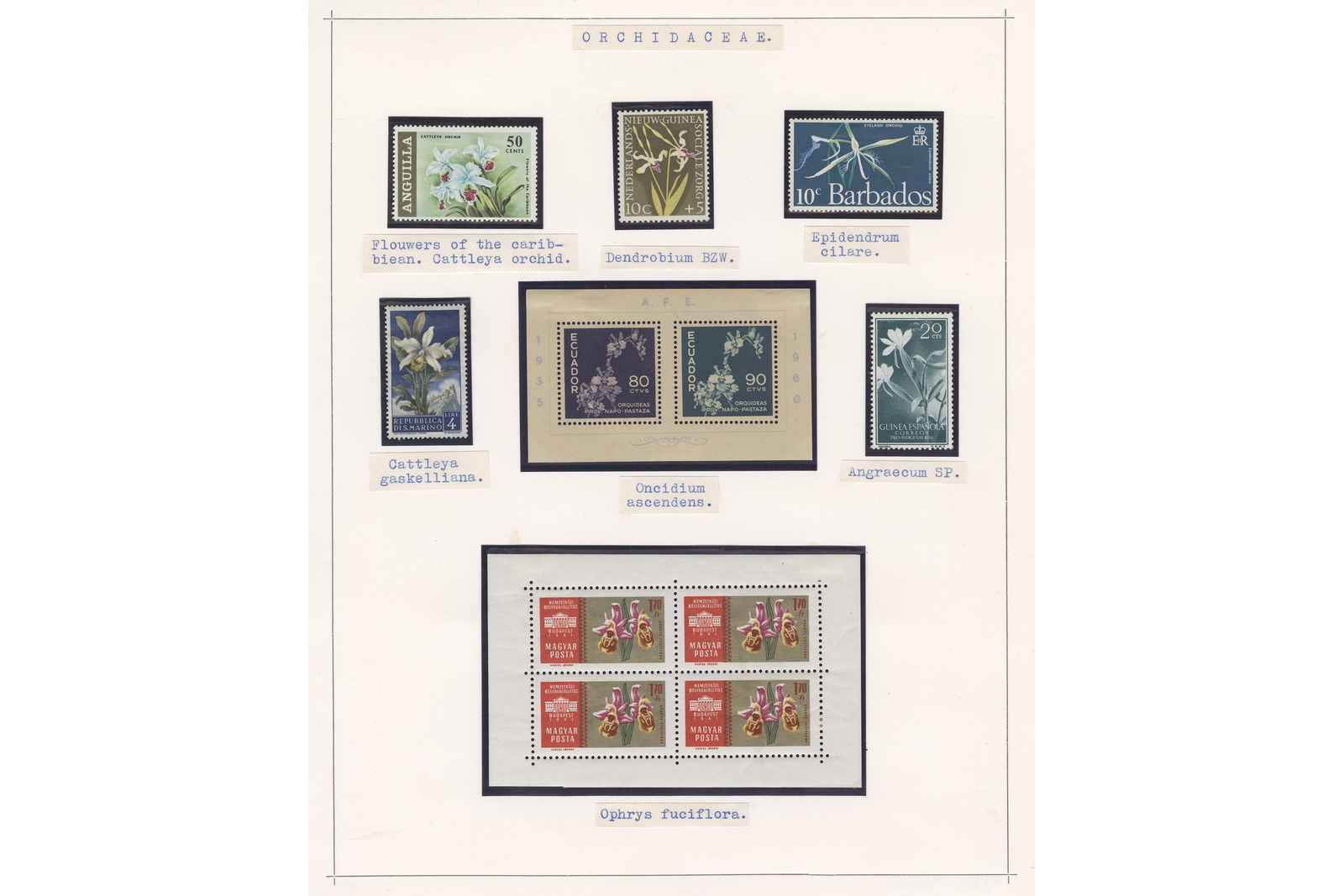
At the top of the page, under the heading "Orchidaceae," there is a row consisting of three separate orchid postage stamps. Below that, there are separate stamps at the edges, with a set of two stamps in the center. At the bottom of the page, there is a set of four stamps. The Latin names are listed below each one.
At the top of the page is the heading "Orchidaceae.gynandrae.fleuranthae." Below this are ten different floral postage stamps: three in each of the top two rows, and below them, a group of two horizontal stamps placed side by side. The Latin name appears beneath each stamp.
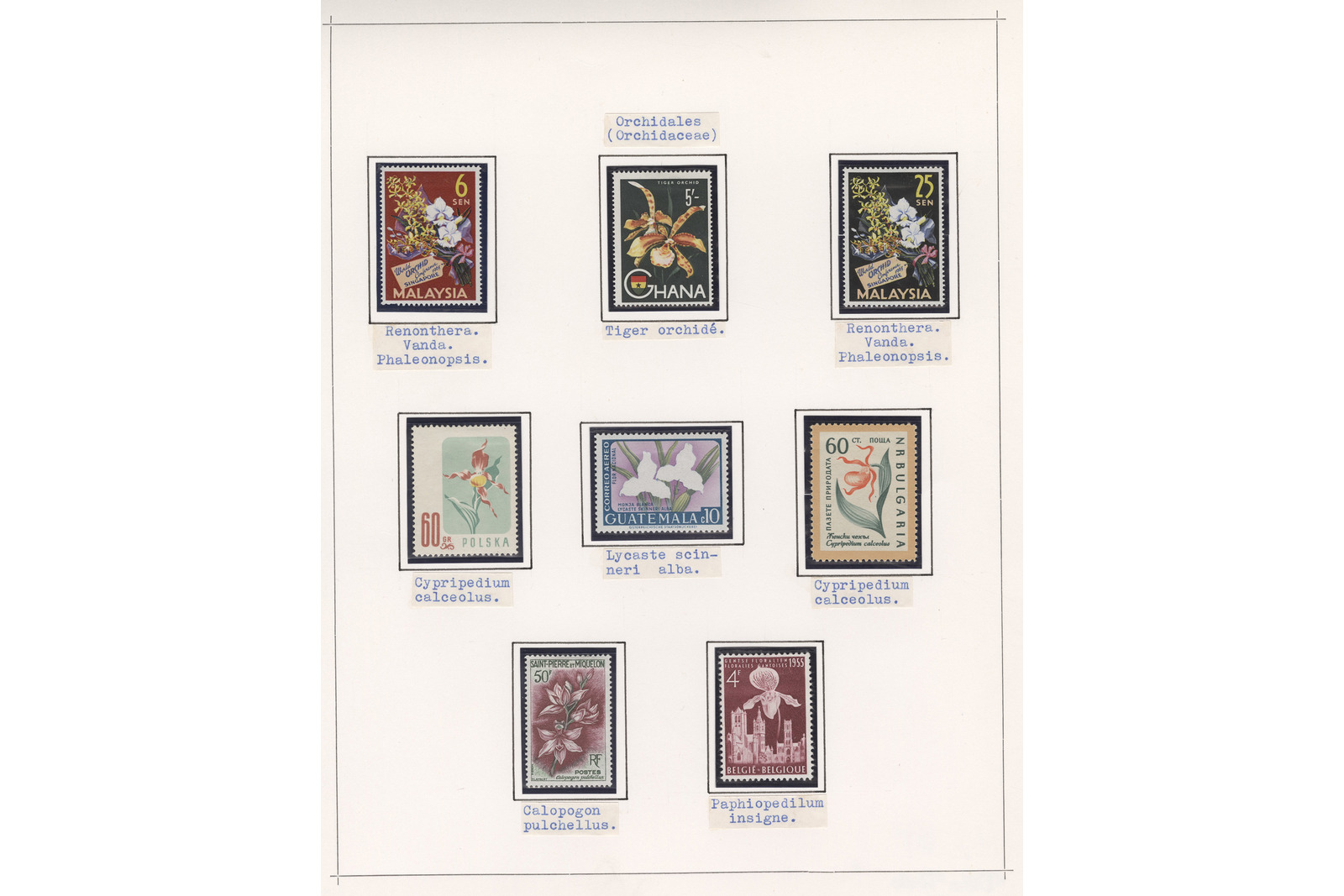
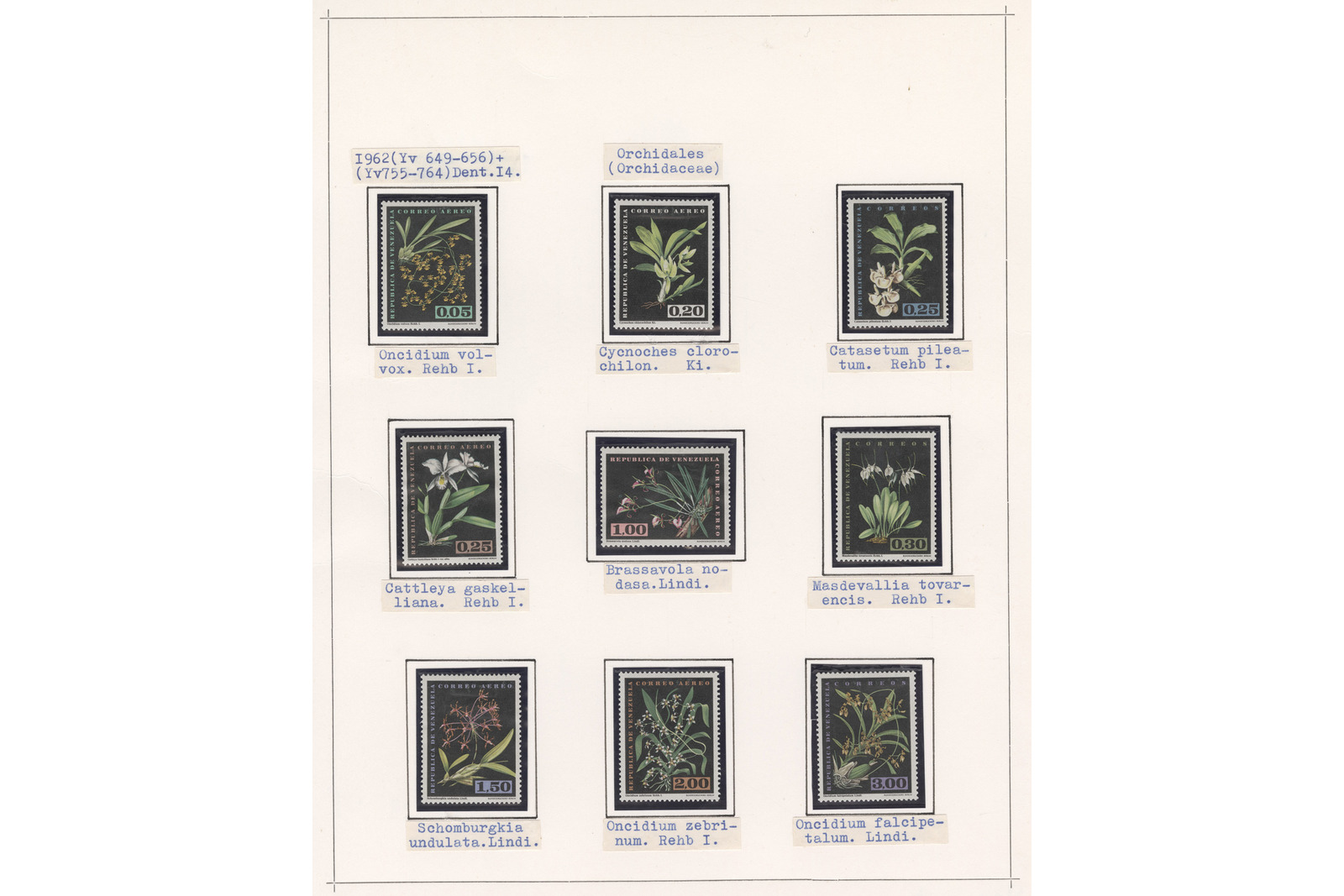
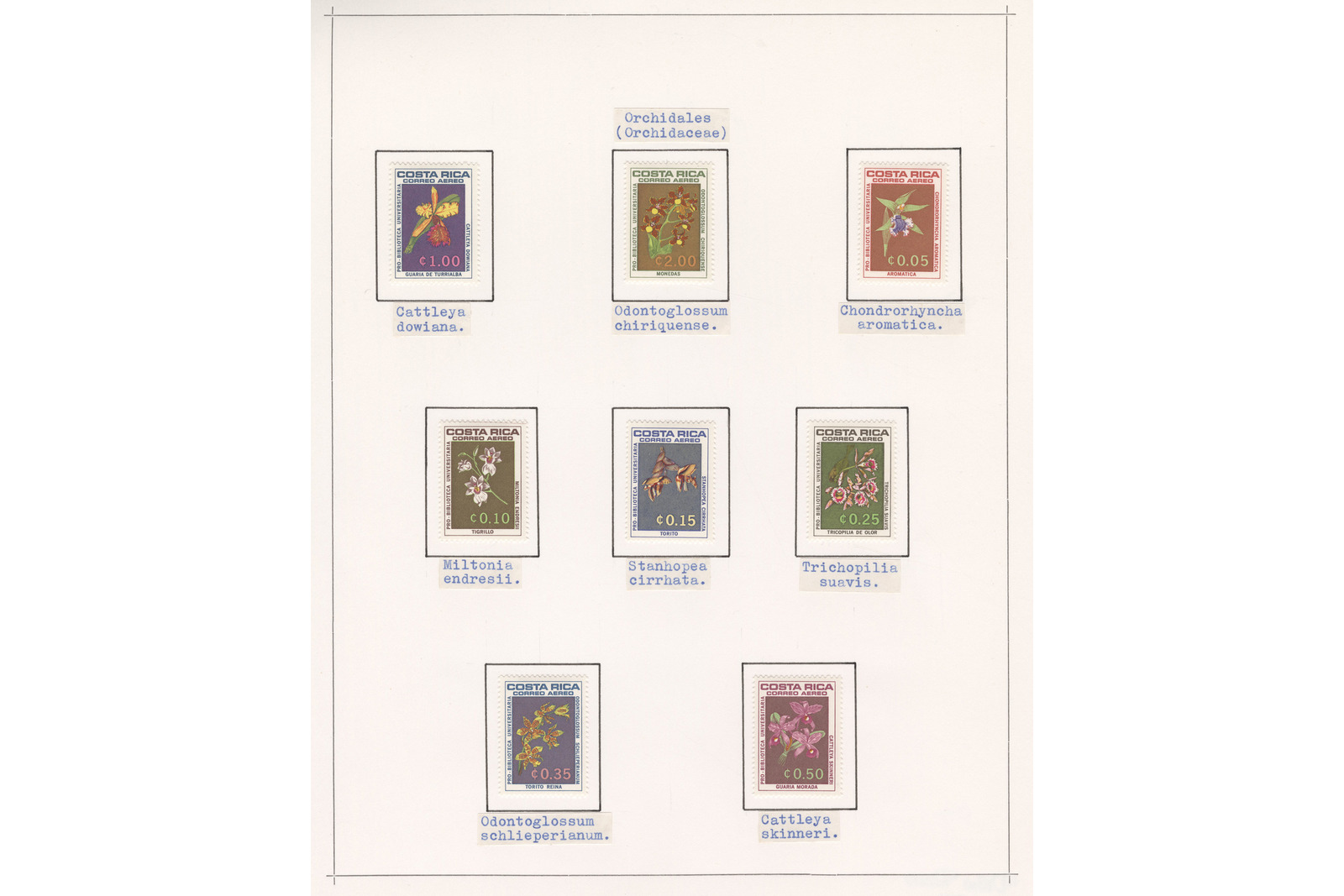
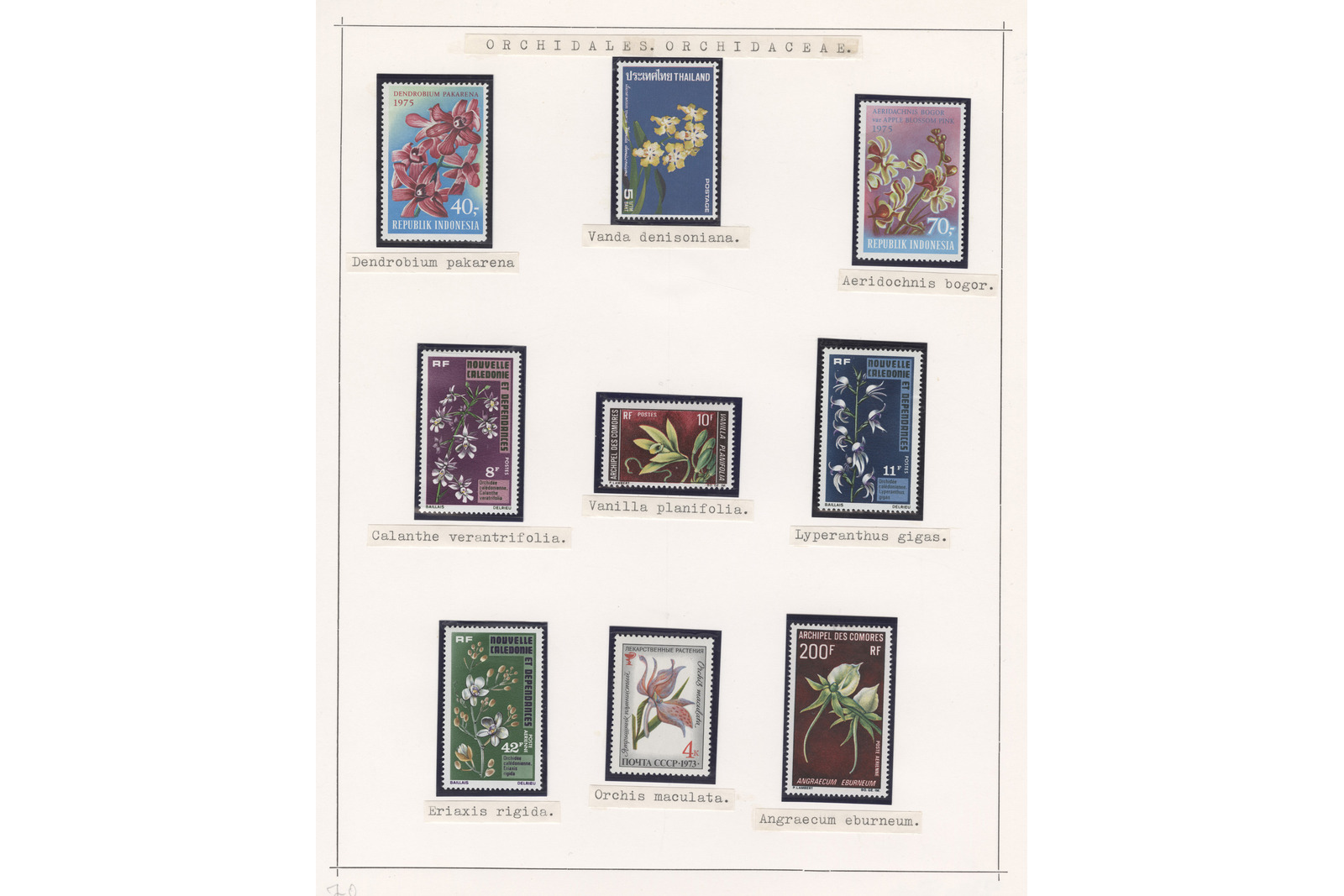
At the top of the page is the heading "Orchidales (Orchidaceae)." Below this are eight different orchid stamps, with three in each of the top two rows and one in the bottom row. The Latin name is printed below each stamp.
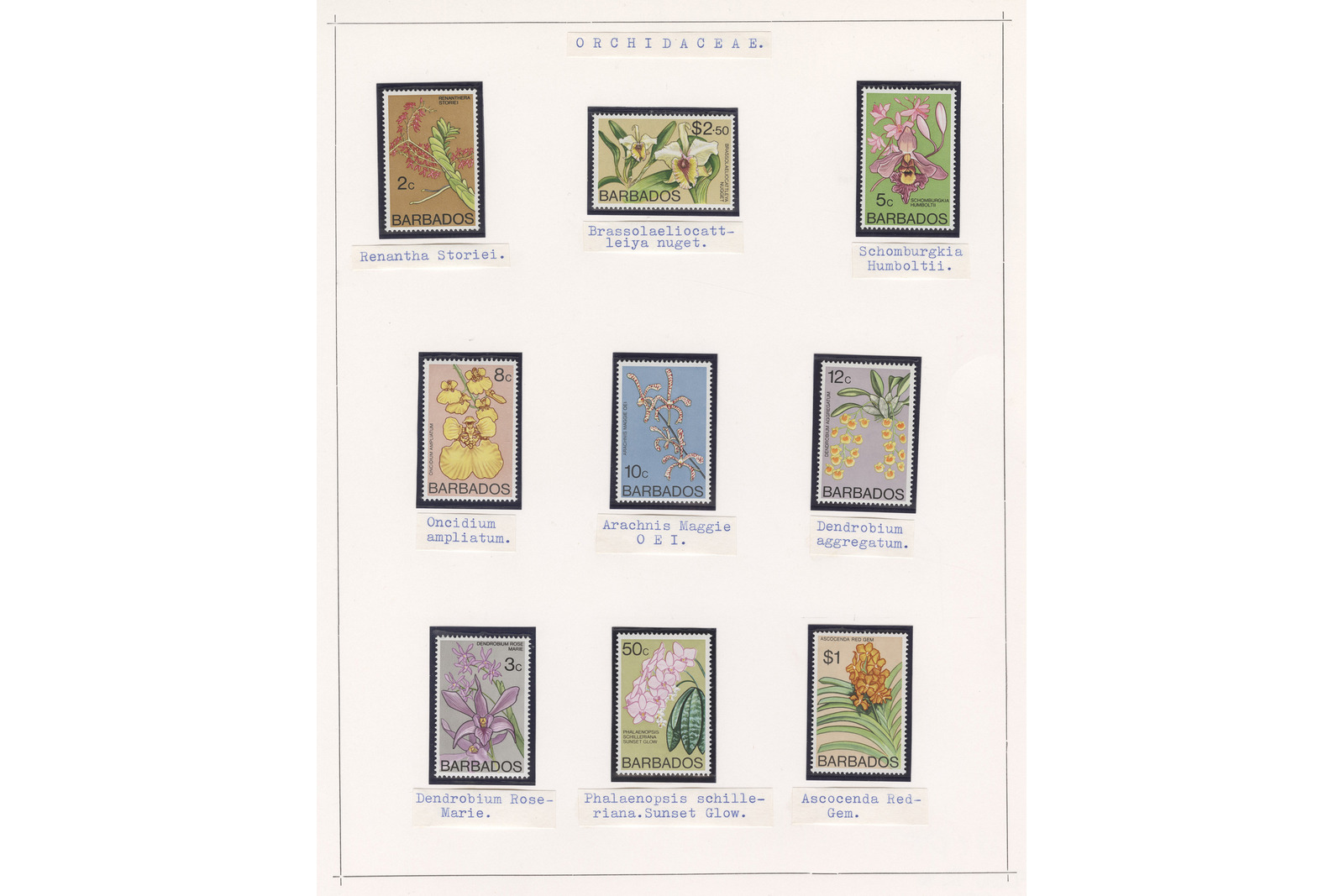
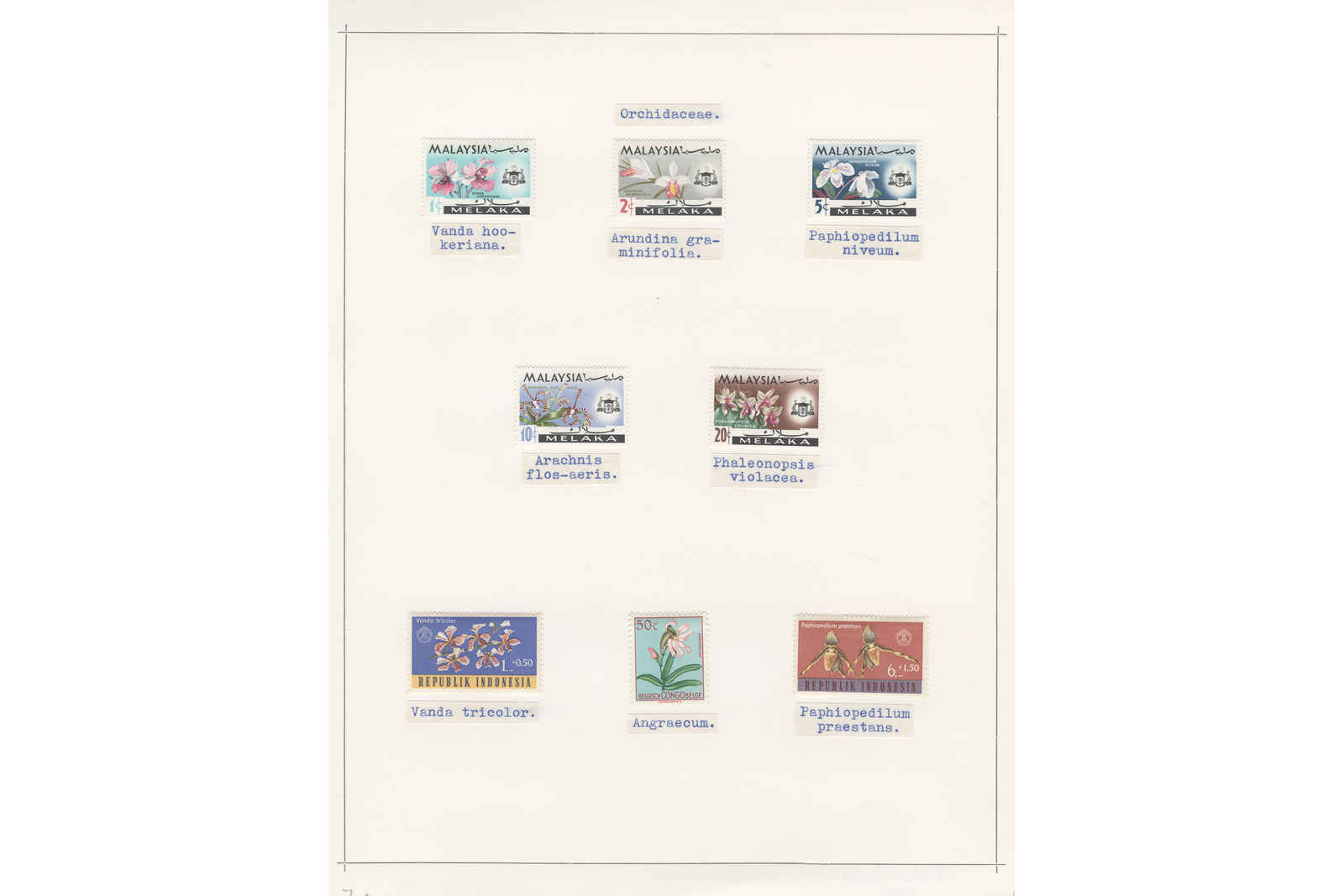
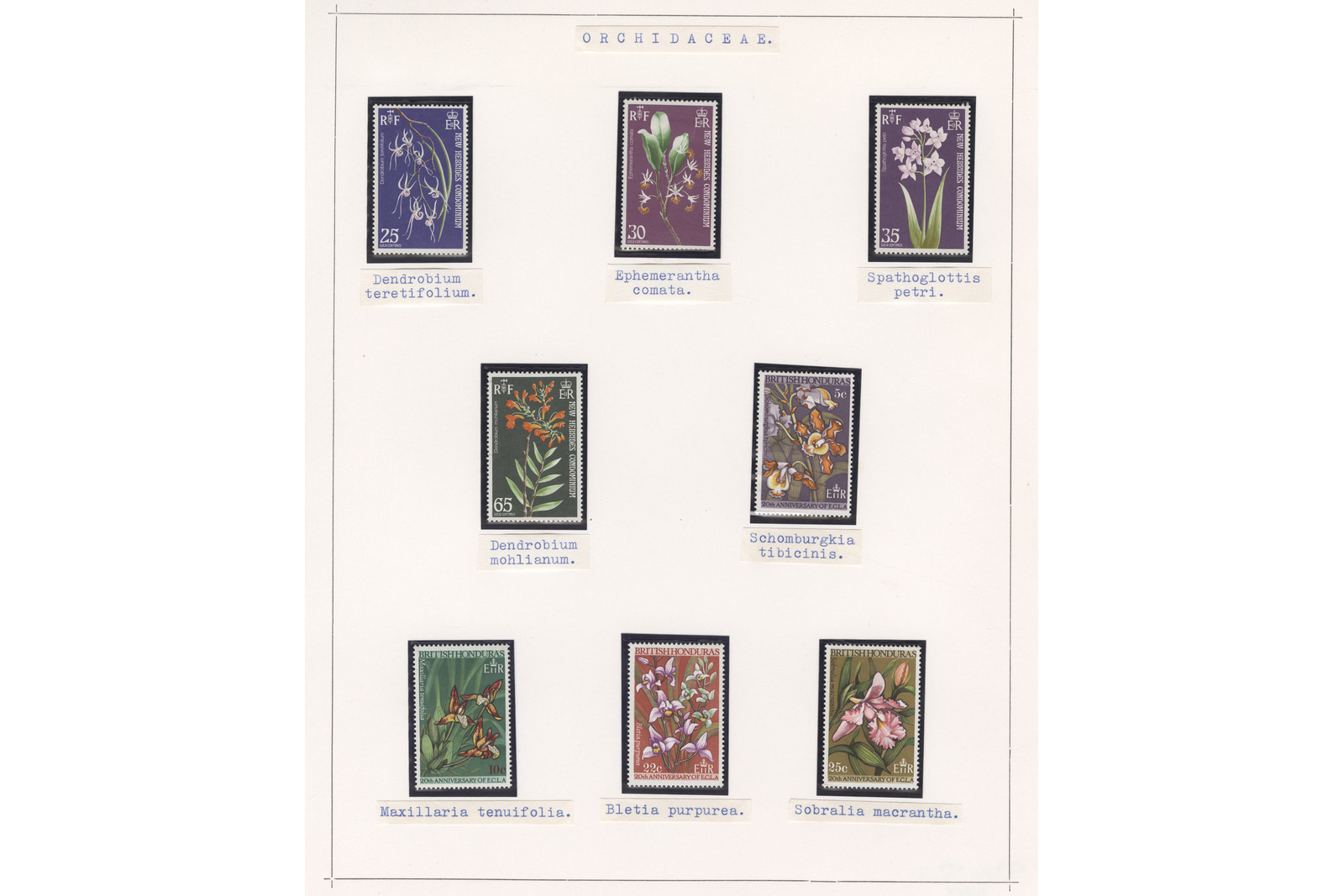
At the top of the page is the heading "Orchidaceae." Below this are nine different orchid stamps, arranged in three per row. The Latin name is printed below each stamp.
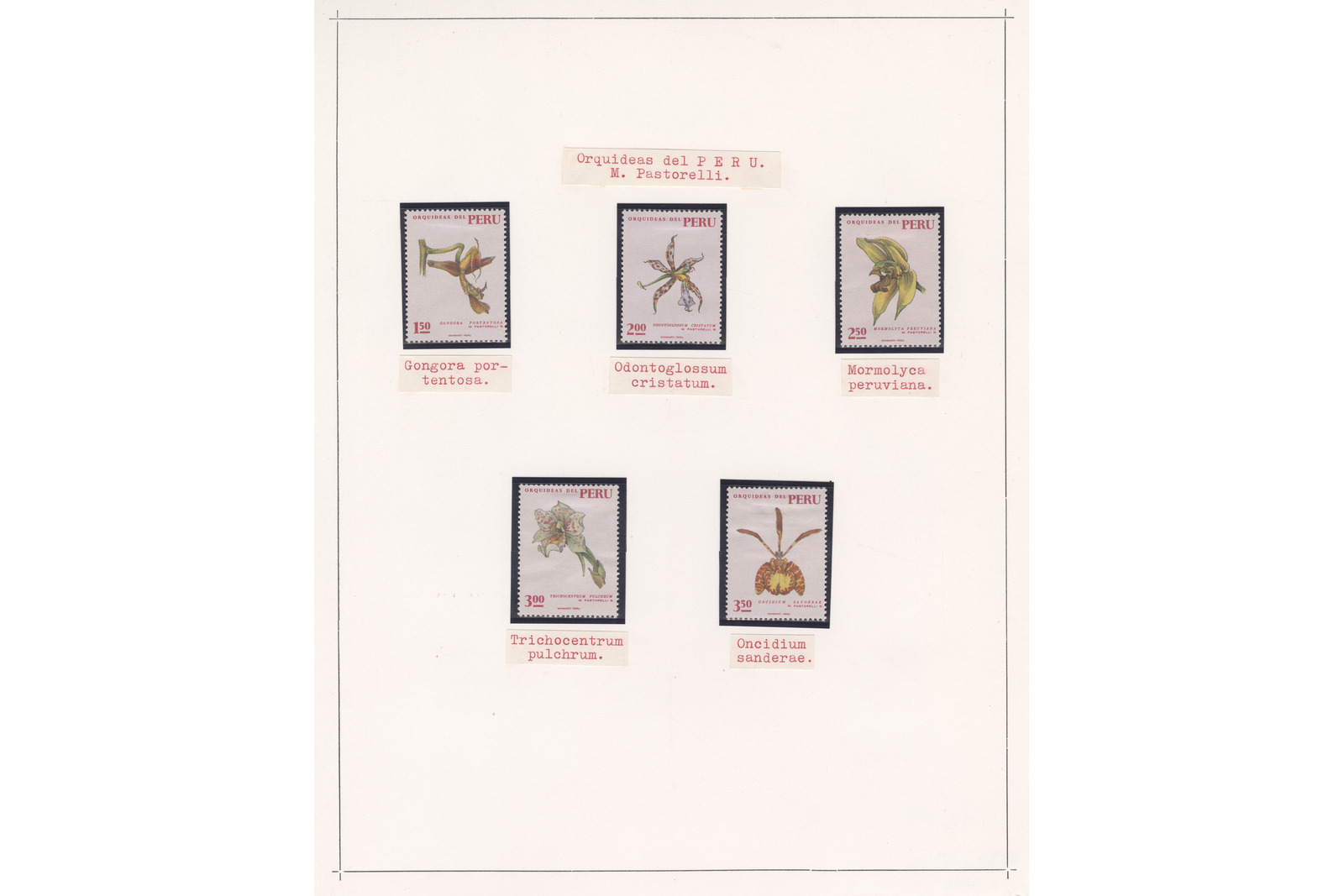
At the top of the page is the heading "Orquideas del PERU. M. Pastorelli." Below this are five different orchid stamps, with three in the first row and two in the second. The name is written in Latin beneath each stamp.
At the top of the page is the heading “Orchidaceae.” Below this are six different orchid stamps, with five of the diagonal stamps arranged in a five-point formation. The horizontal stamp is below them. The Latin name appears beneath each stamp.
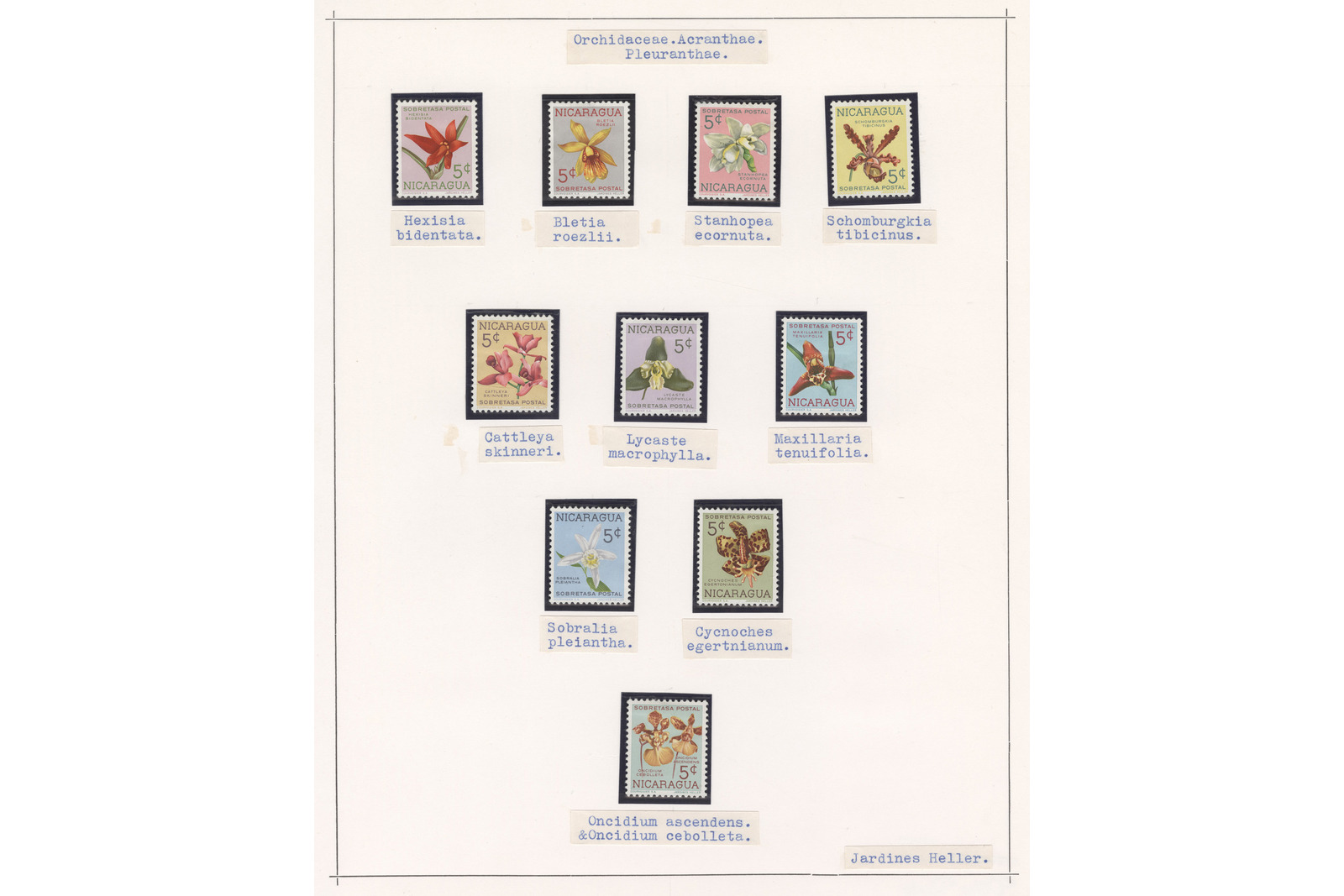
At the top of the page is the heading "Orchidaceae.Acranthae.Fleuranthae." Below this are ten different flower postage stamps arranged as follows: four in the first row, three in the second, two in the third, and one in the fourth. The Latin name is printed below each stamp.
At the top of the page is the heading "Orchidaceae.Fleuranthae." Below this are eight different flower stamps: three in the first and second rows, and two in the last row. The Latin name is written below each stamp.
At the top of the page is the heading “Orchidales (Orchidaceae).” Below this are two different flower stamps side by side. Below these is a new heading, “1967 (Yv 455-66) Dentelé I4,” under which are four stamps arranged in a diamond pattern. The name in Latin appears beneath each stamp.
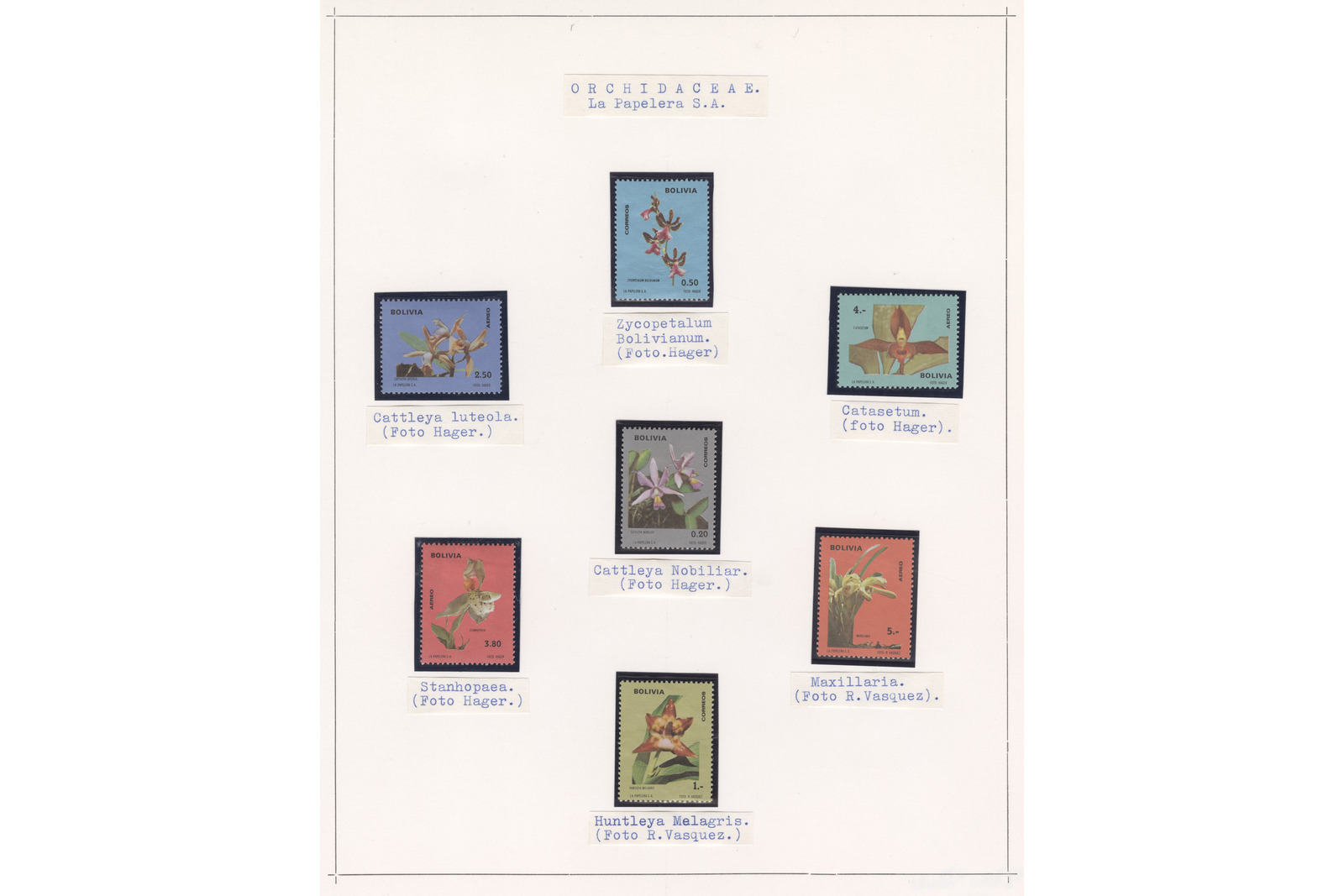
At the top of the page is the heading “Orchidaceae. La papelera S.A.” Below this are three different floral postage stamps arranged side by side. Below these are four stamps arranged in a diamond pattern. The Latin name appears beneath each stamp.
At the top of the page is the heading "Orchidaceae." Below this are three different flower stamps arranged in three rows. The Latin name appears beneath each stamp.
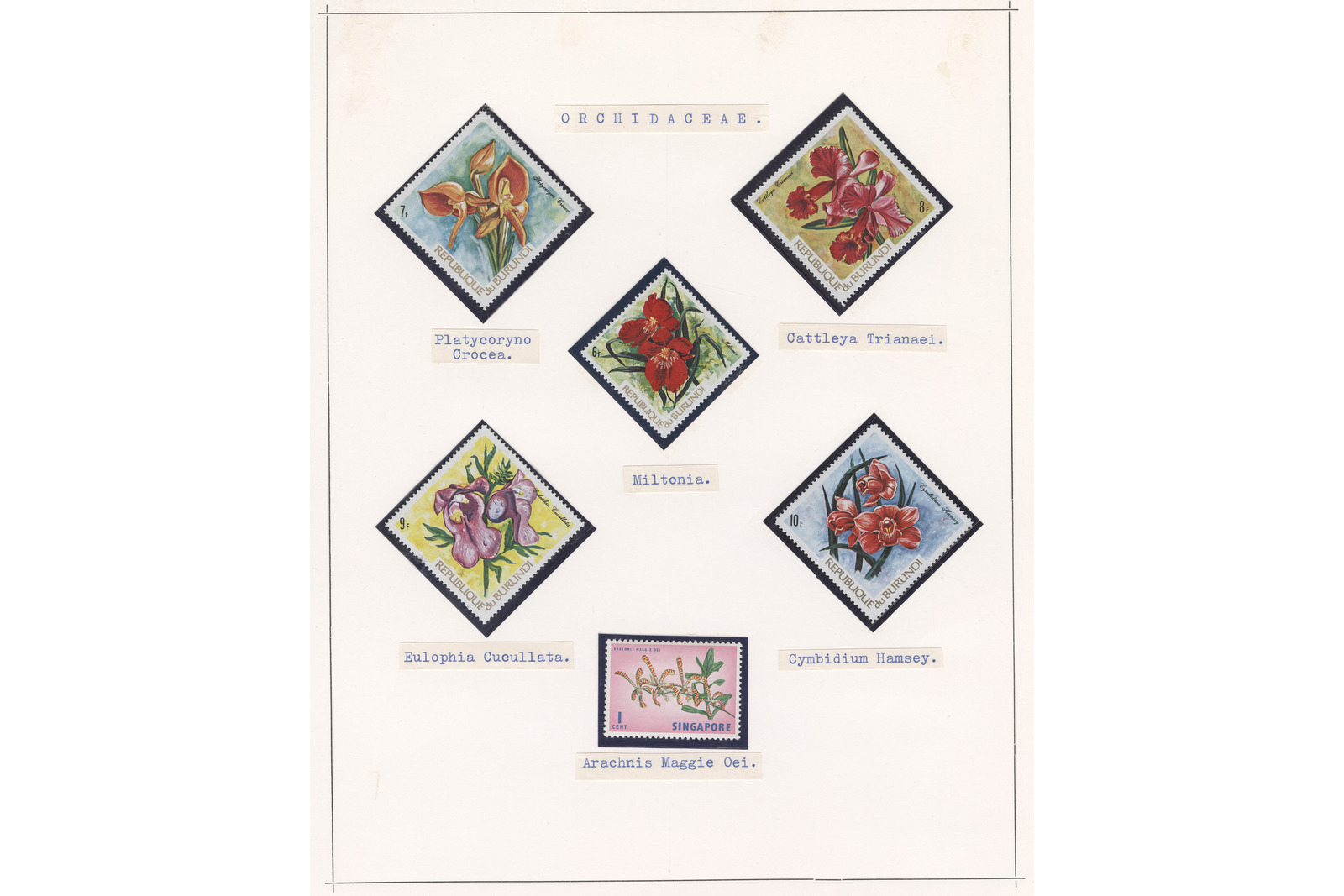
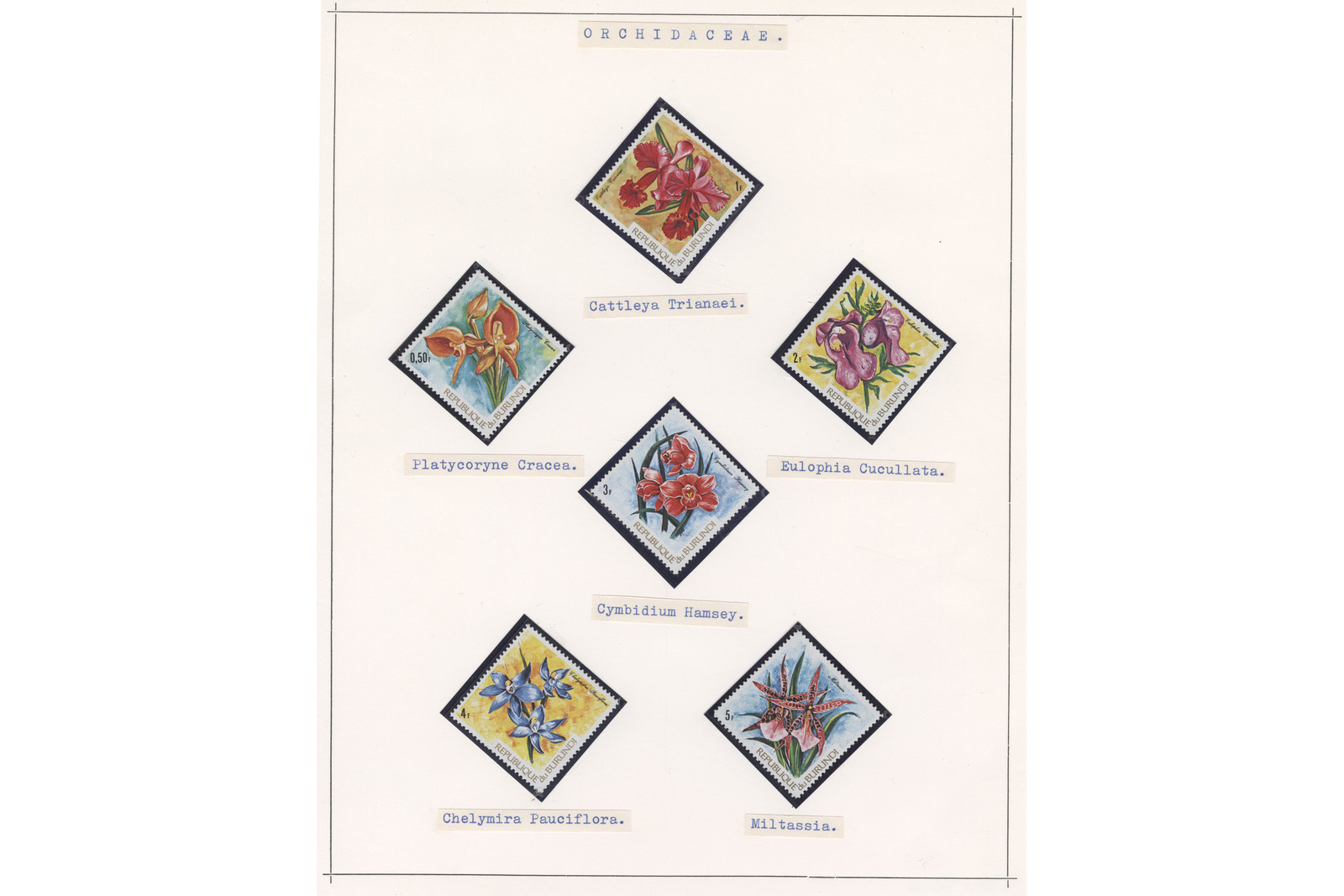
At the top of the page is the heading "Orchidaceae." Below this are four different oblique-angled orchid stamps arranged in a diamond pattern. Below these are two stamps side by side. The Latin name appears beneath each stamp.
At the top of the page is the heading "Orchidaceae." Below that are nine orchid stamps arranged in three rows. The Latin name appears below each stamp.
At the top of the page is the heading "Orchidaceae." Below this are eight orchid stamps, with three in each of the top two rows and two in the bottom row. The Latin name is listed below each stamp.
At the top of the page is the heading "Orchidaceae." Below this are eight orchid stamps, with three in the top and bottom rows and two in the middle row. The Latin name appears below each stamp.
Sivun ylhäällä on otsikko Orchidaceae. Tämän alapuolella kuusi orkideapostimerkkiä kolmessa rivissä kussakin kaksi. Jokaisen merkin alla on latinankielinen nimi.
At the top of the page is the heading "Orchidaceae." Below this are eight orchid stamps, with three in the top and bottom rows and two in the middle row. The Latin name is listed below each stamp.
At the top of the page is the heading “Orchidaceae.” Below this are seven orchid stamps arranged in three columns. The outer columns contain only two stamps each, while the middle column has three, which begin higher up than the stamps in the outer columns. Below that are four stamps in a row. The Latin name is listed below each stamp.
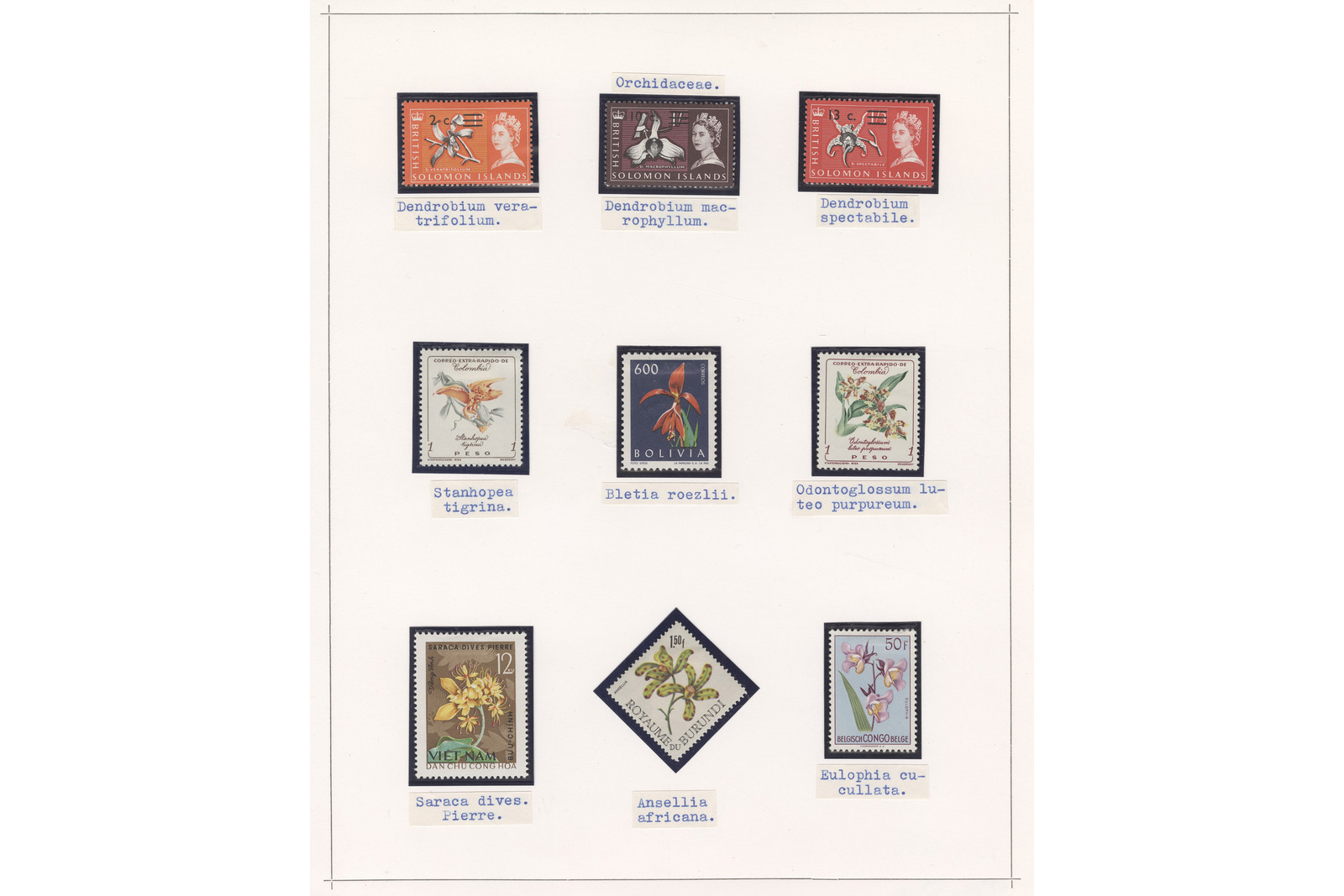
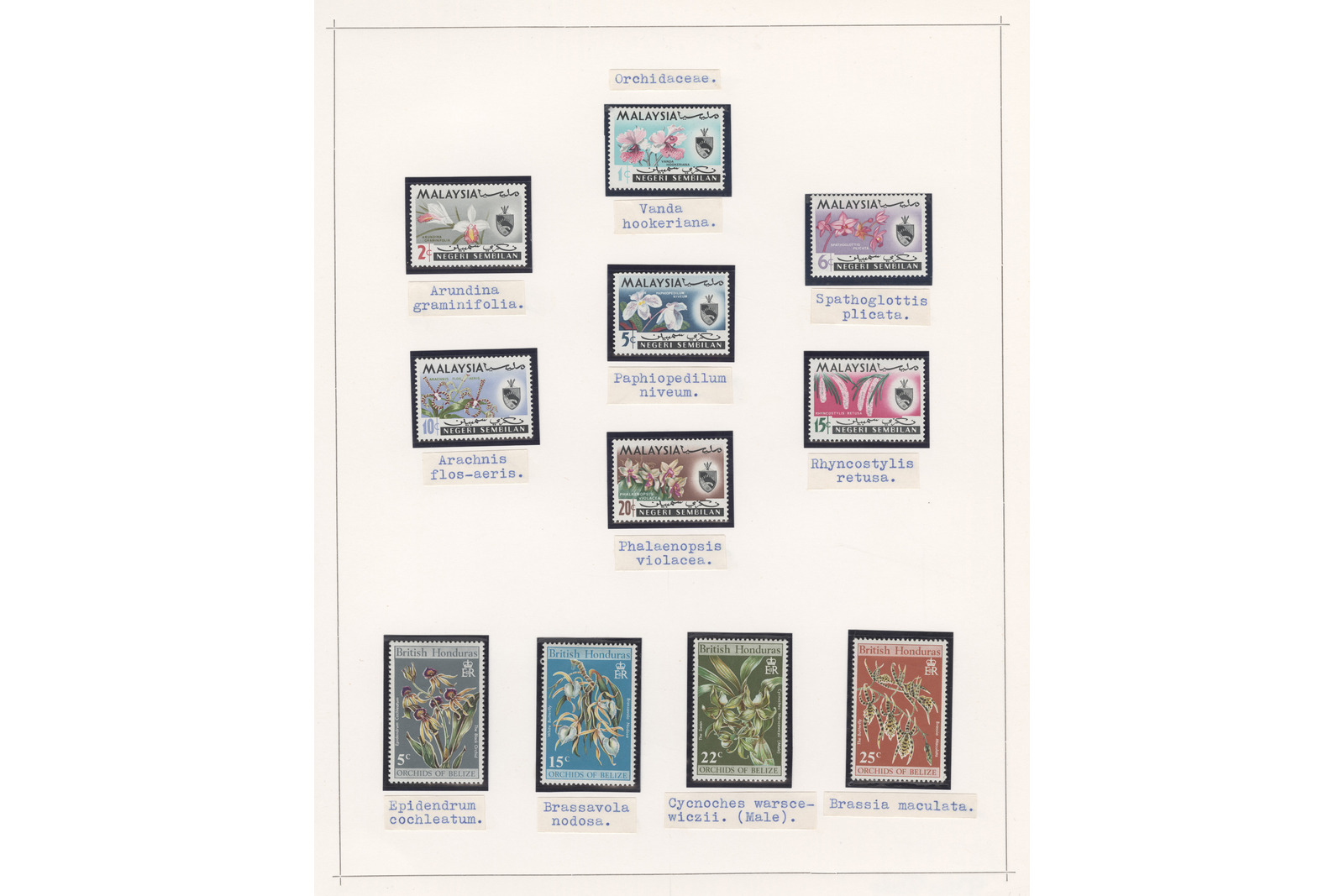
At the top of the page is the heading "Orchidaceae." Below this are nine orchid stamps, arranged in three stamps per row. The Latin name appears below each stamp.
At the top of the page is the heading "Orchidaceae." Below this are eight different orchid stamps, with three in the top and bottom rows and two in the middle row. The Latin name is listed below each stamp.
At the top of the page is the heading "Orchidaceae." Below this is a set of three postage stamps, with the heading "República de Colombia" above them. The Latin names are printed around the set.
At the top is the heading "Orchidaceae," and in the center is the address. Below that is a larger photo of a flower, and in the lower right corner is a smaller version of the same photo.
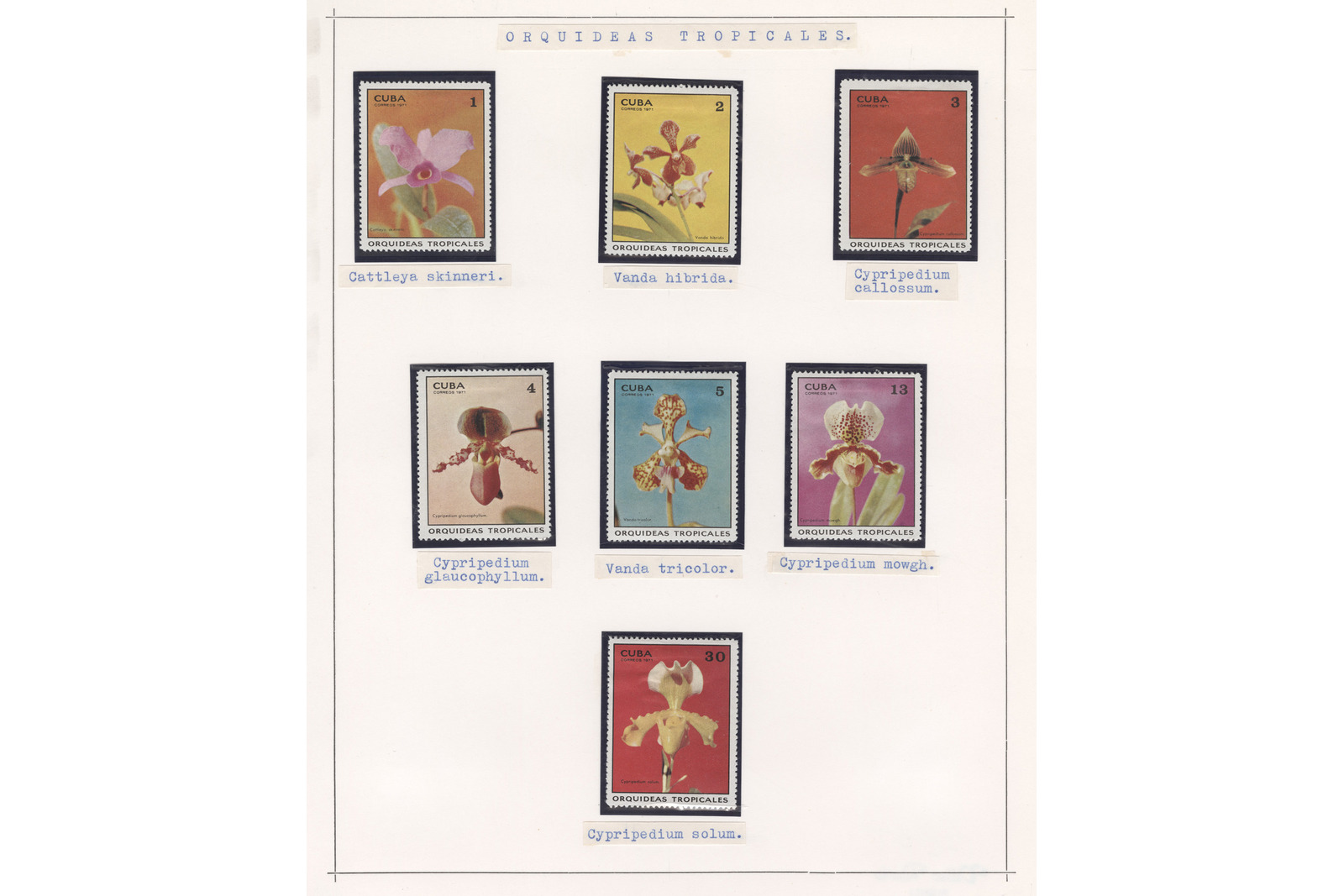
At the top of the page is the heading "Orchideas Tropicales." Below this are seven different orchid stamps, with three stamps in each of the top two rows and one in the bottom row. The Latin name is listed below each stamp.
At the top of the page is the heading "Orchideas Tropicales." Below this are two different orchid stamps side by side. The same stamps appear in the upper right corner of the envelope below. Below the stamps at the top are their Latin names.
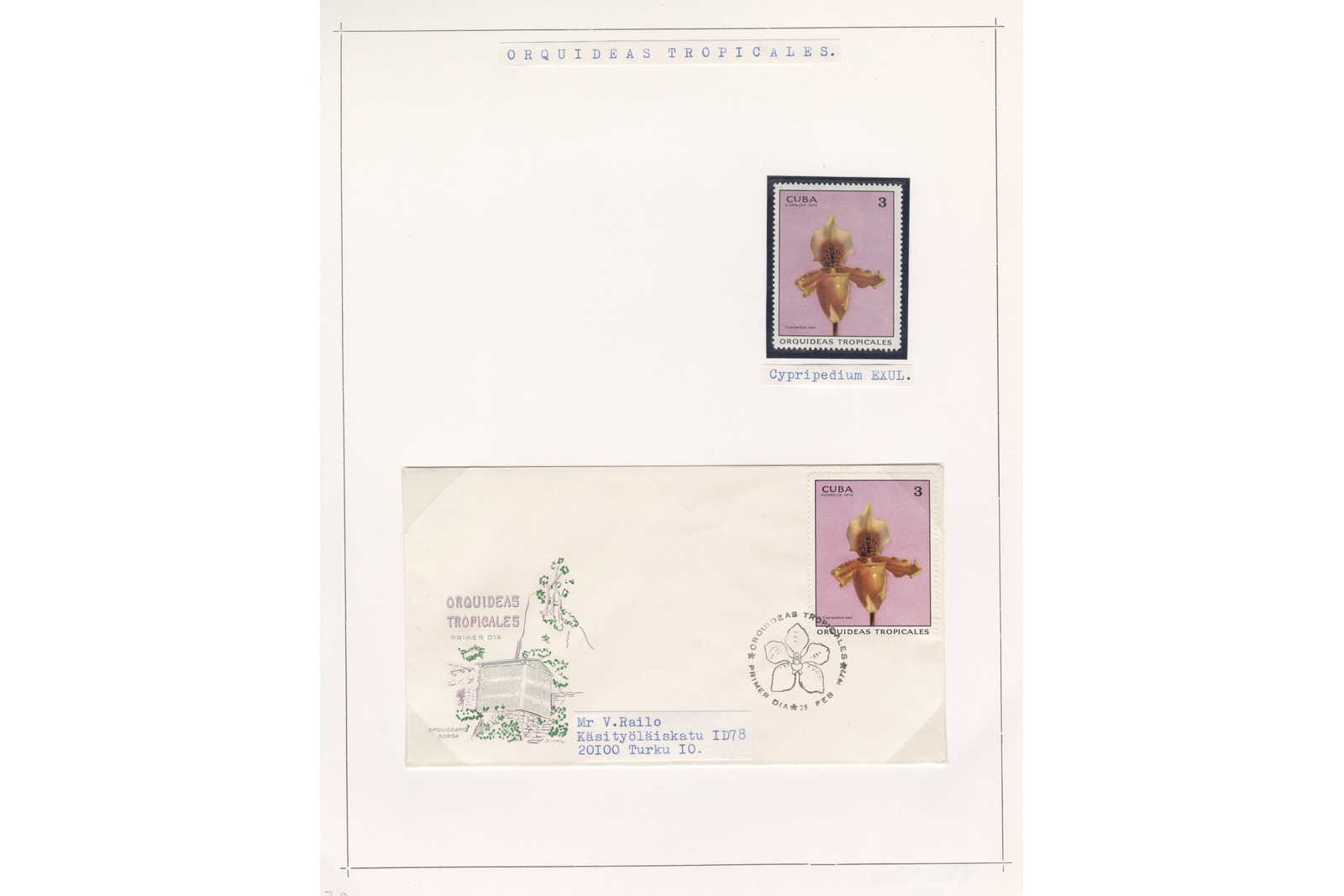
At the top of the page is the heading "Orchideas Tropicales." Below this is an orchid postage stamp. The same stamp appears in the upper right corner of the envelope below. The Latin name of the orchid is printed below the stamp at the top.
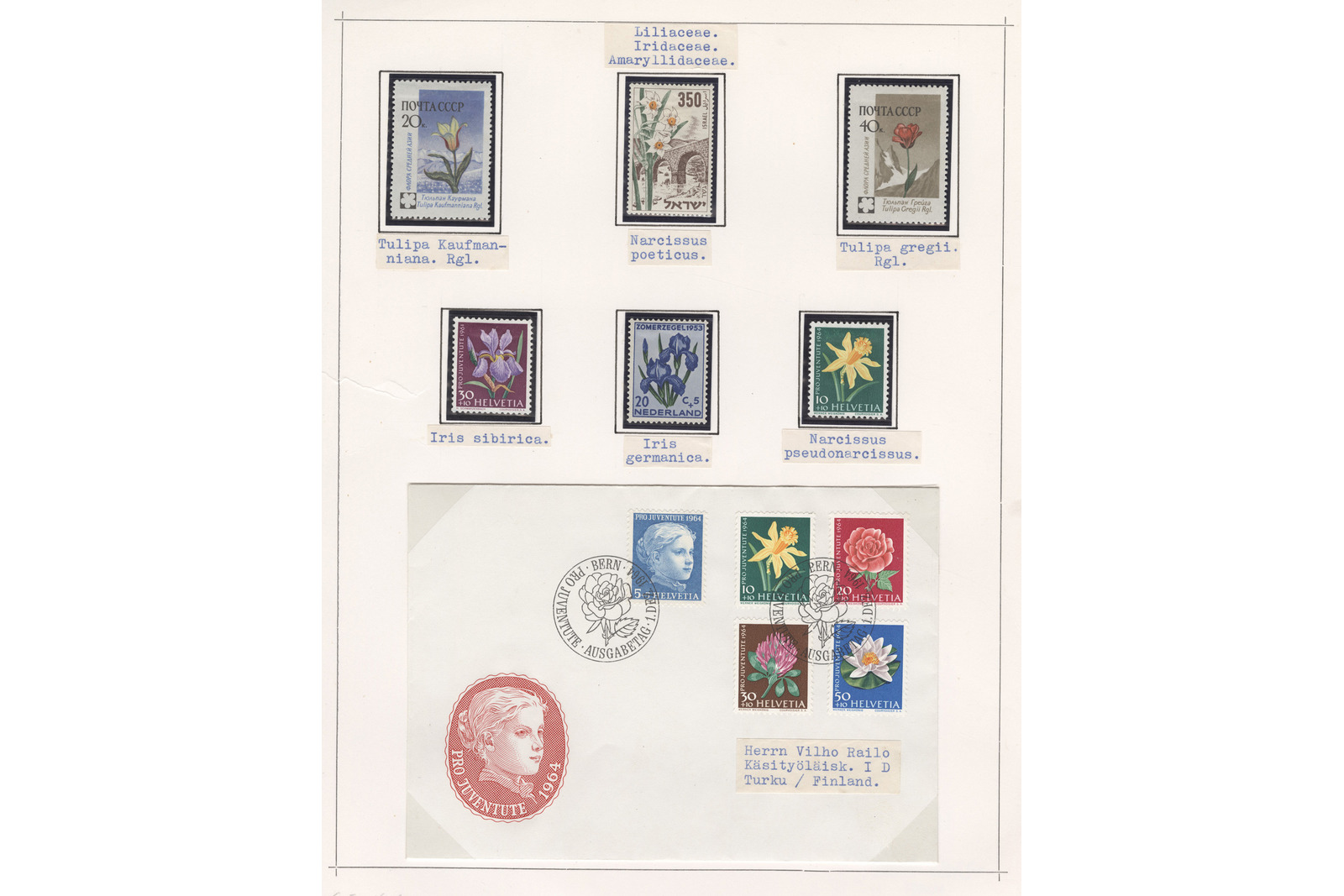
At the top of the page is the heading “Liliaceae. Iridaceae. Amaryllidaceae.” Below this are six flower stamps arranged in two rows. On the envelope below them, there are four flower stamps in pairs in the upper right corner. One of them is the same as the last stamp in the set of individual stamps. Below each stamp is its Latin name.
At the top of the page is the heading “Liliaceae.Amaryllidaceae.” Below this are six flower stamps arranged in two rows. Below these are two stamps, with a stamp section cut from an envelope—featuring a flower stamp—between them. The Latin name for each stamp is written below it.
At the top of the page is the heading "Liliaceae.Amaryllidaceae." Below this are nine flower stamps arranged in three rows. The Latin name for each stamp is listed below it.
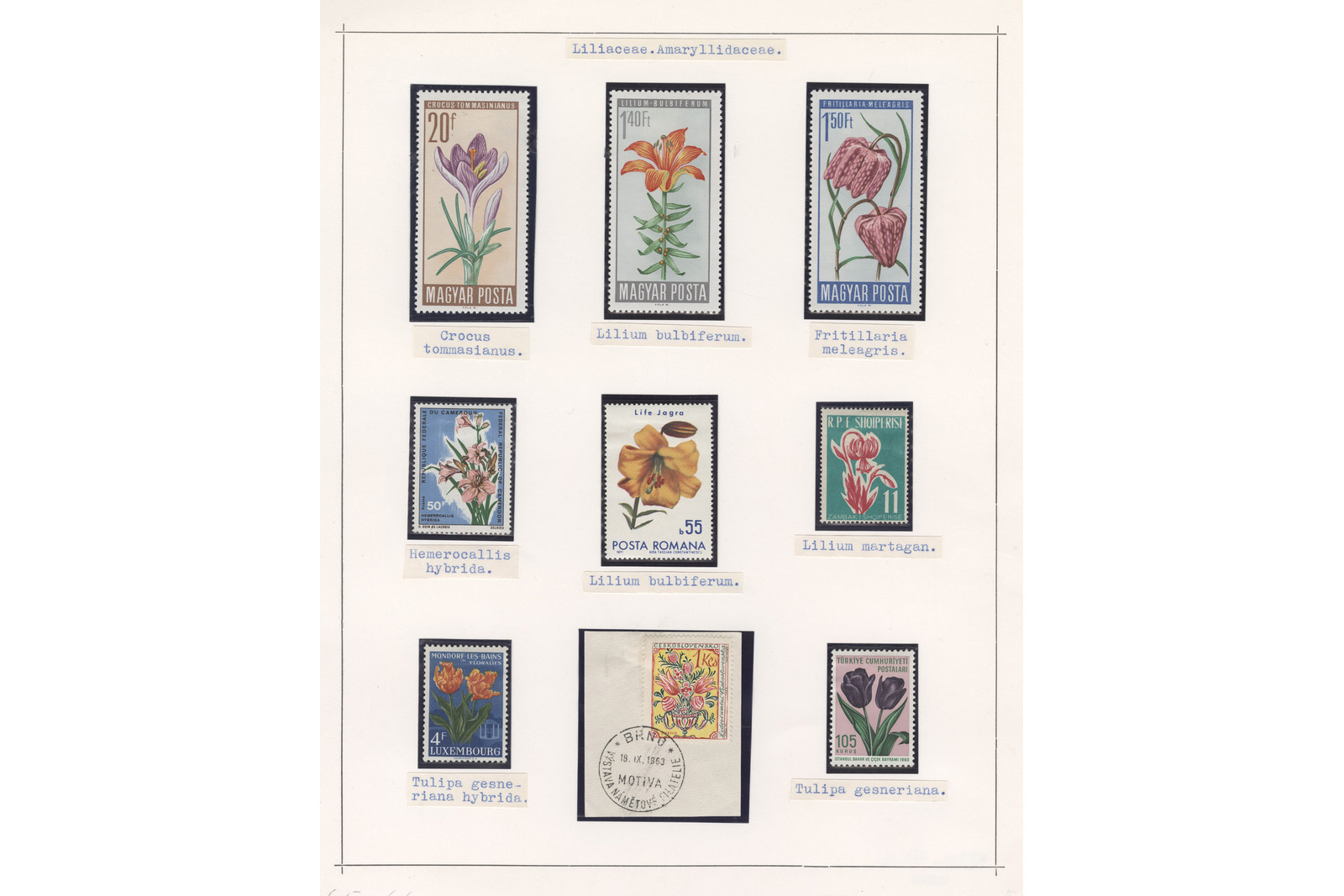
At the top of the page is the heading “Liliaceae.Amaryllidaceae.” Below this are nine flower stamps arranged in three rows, with the middle stamp in the bottom row positioned at the corner of the envelope. The Latin name for each stamp is listed below it.
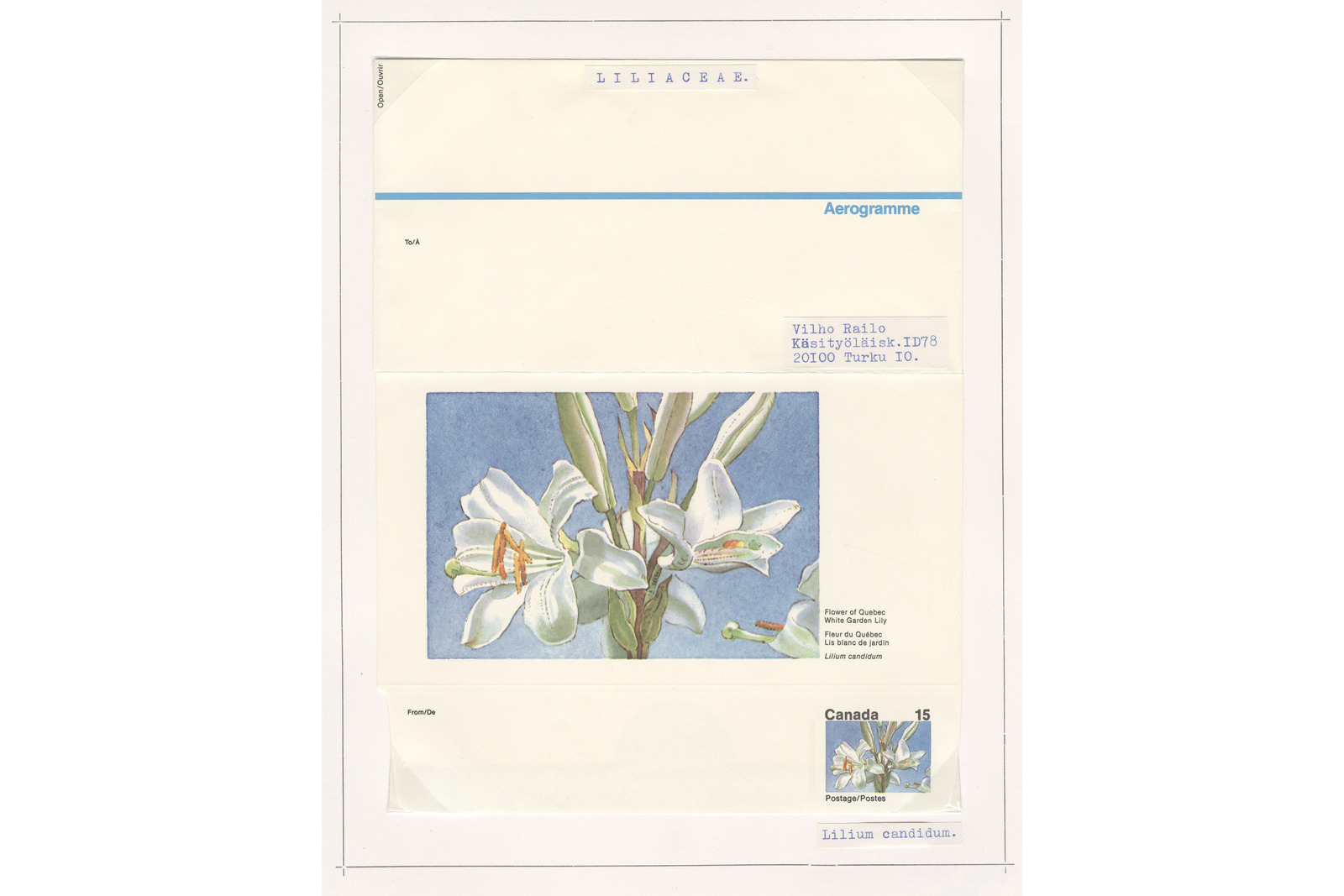
At the top is the heading "Liliaceae," and in the center is the address. Below that is a larger photo of a flower, and in the lower right corner is a smaller version of the same photo.
At the top is the heading "Liliaceae," beneath which are six flower stamps arranged in two rows. Below that is an envelope with a flower stamp in the upper right corner. Each stamp is accompanied by its Latin name.
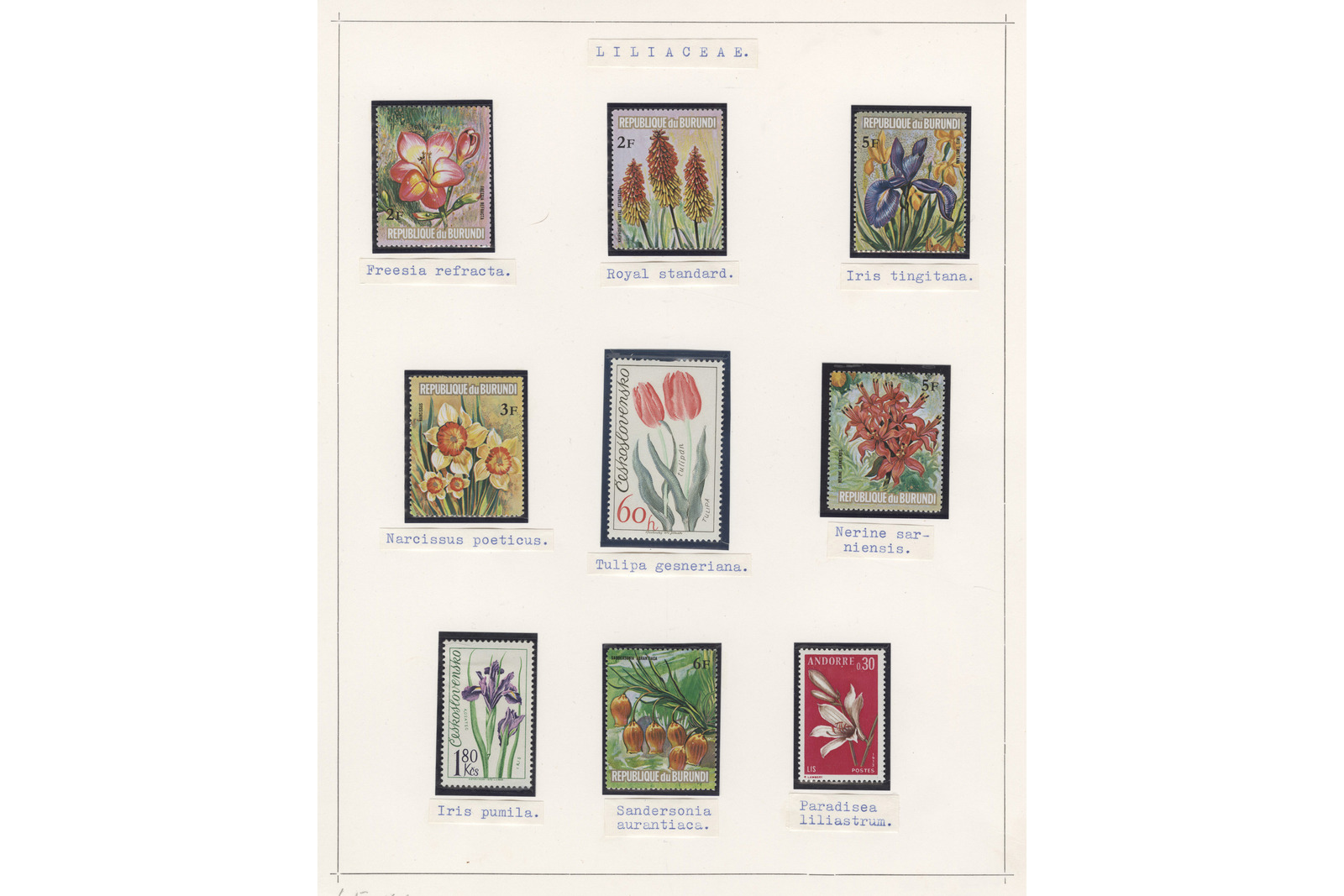
At the top is the heading "Liliaceae," beneath which are nine flower stamps arranged in two or three rows. The Latin name for each stamp appears below it.
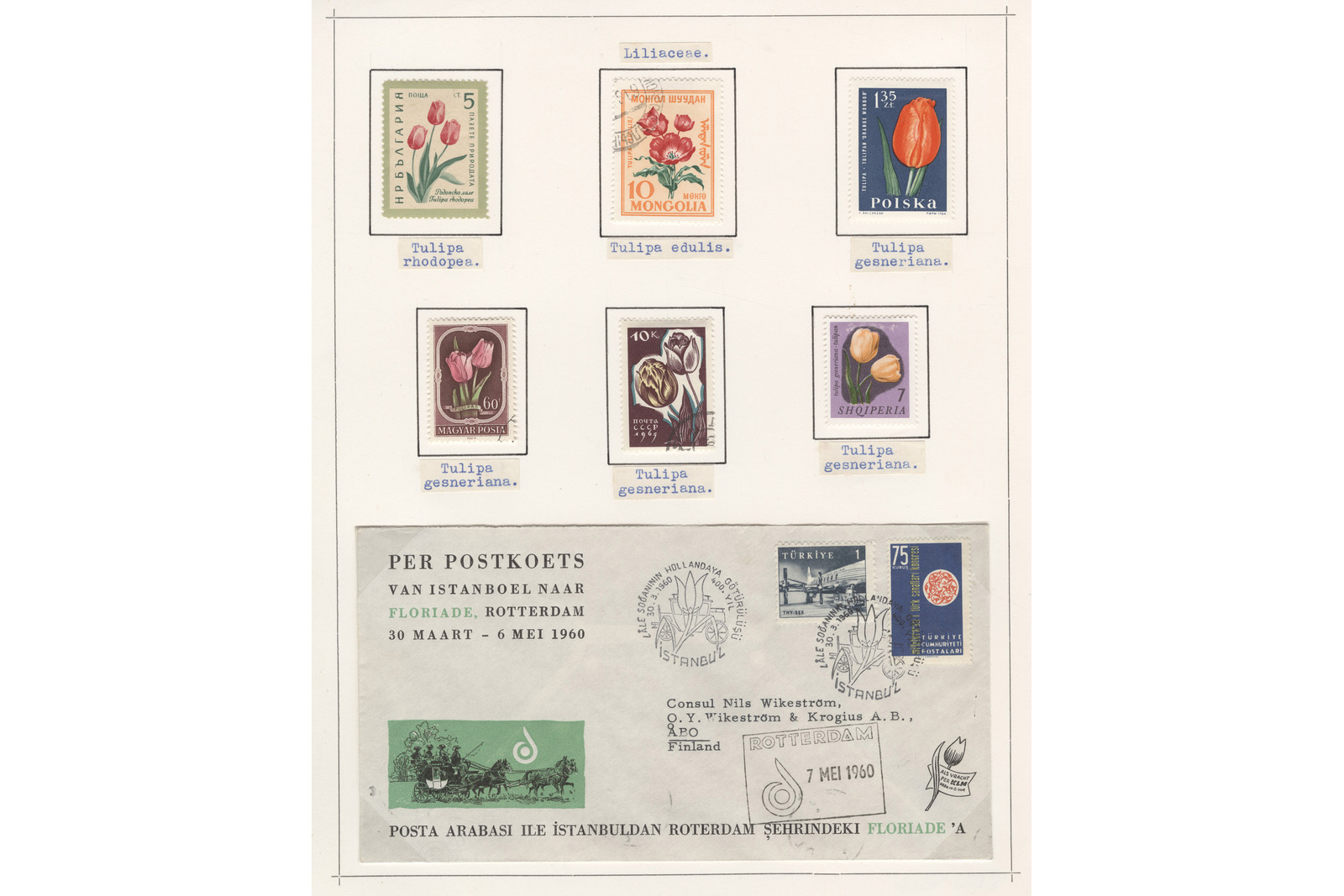
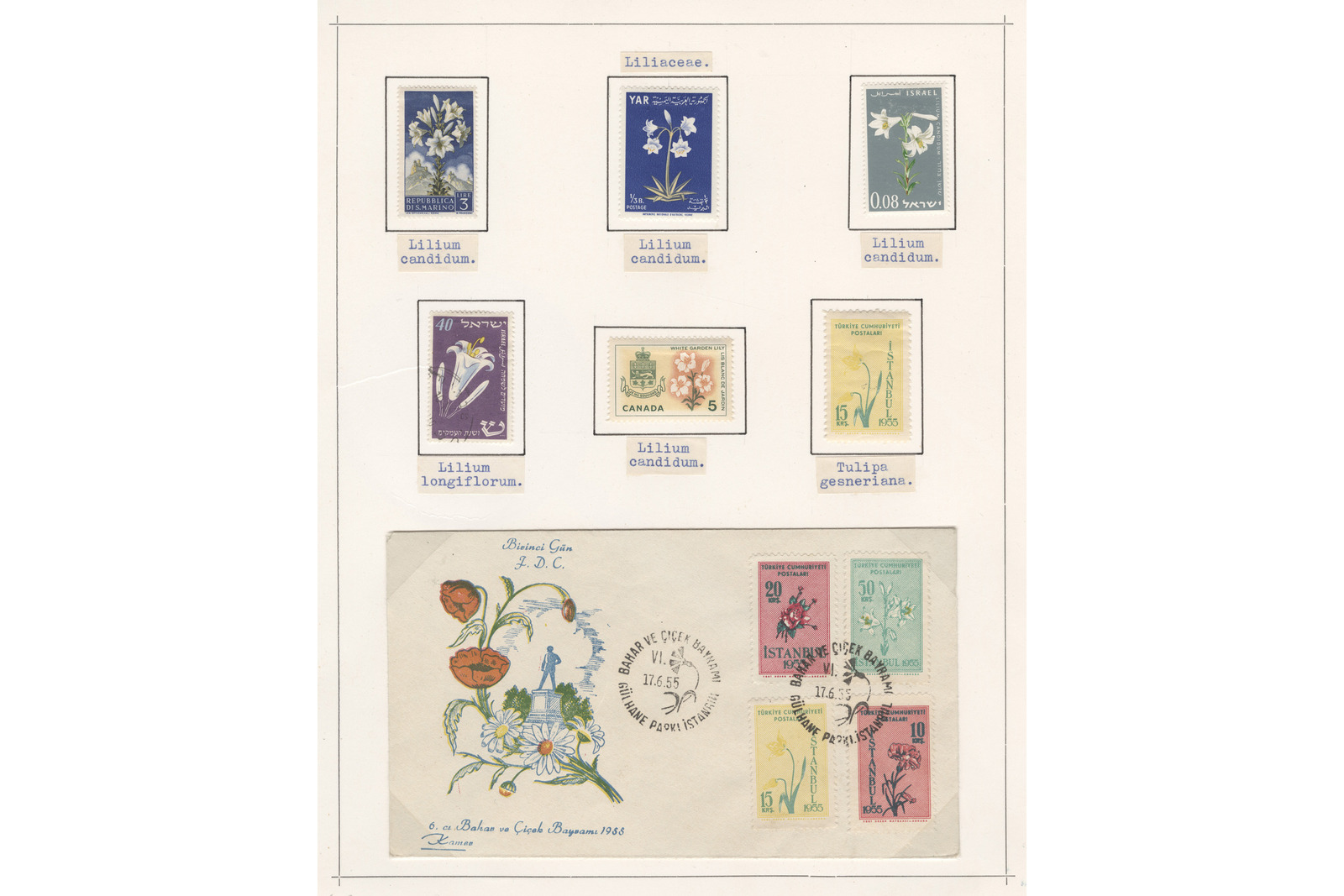
At the top is the heading "Liliaceae," with six flower stamps arranged in two rows below it. Below that is an envelope with four flower stamps in the upper right corner. The envelope features an illustration of a flower. The Latin name appears below each stamp.
At the top is the heading "Liliaceae," with six flower stamps arranged in two rows below it. Below that is an envelope with two flower stamps in the upper right corner. The Latin name appears below each stamp.
At the top is the heading "Liliaceae," beneath which are six flower postage stamps arranged in two rows. Below that is an envelope with two flower postmarks at the top. The Latin name appears beneath each stamp.
At the top is the heading “Liliaceae,” beneath which are six flower stamps arranged in two rows. Below that is an envelope with one flower stamp in the upper right corner. The envelope features an illustration of a flower. The Latin name appears beneath each stamp.
At the top is the heading "Liliaceae," beneath which are nine flower stamps arranged in two or three rows. The Latin name for each stamp appears below it.
At the top of the page is a black-and-white photograph of a man holding an award. Below it is some text. Flowers. The collection was assembled and curated by Chief Engineer Vilho Railo (1896–1978). The collection was bequeathed to the Postal Museums of Norway and Finland.
At the top is the heading "Rosachae," in the center is the address, and below that is a larger picture of a flower, with a smaller version of the same image in the lower right corner.
The page features ten different rose postage stamps, with their names in various languages listed below them.
The page features nine different rose postage stamps, with their names in Latin listed below them.
At the top of the page, under the heading "Rosaceae," there are six rose stamps, with their Latin names listed below them. At the bottom of the page is an envelope with a rose stamp in the upper right corner.
At the top of the page are three individual rose stamps, and to the right of them is a set of four stamps. At the bottom of the page is an envelope featuring a similar set of four stamps as the one at the top, in the upper right corner.
At the top of the page is the heading "Rosales Rosaceae." Below this are eight different rose stamps, with three in each of the first two rows and two in the last row.
At the top of the page is the heading "Rosales Rosaceae." Below this are nine different rose stamps, arranged in three per row. The Latin name is printed below each stamp.
At the top is the heading "Rosacheae," in the center is the address, and below that is a larger photo of a flower, with a smaller version of the same photo in the lower right corner.
At the top of the page is the heading "Rosaceae." Below this are eight different rose stamps arranged as follows: one at the top, two in the middle—flanked by oblique-angled stamps—and three in the bottom row. Below them is the text "Rosa Danascena."
At the top of the page is the heading "Rosaceae." Below this is a circular pair of stamps featuring a woman’s profile and text. Below that is the heading “Rosa Pendulina. L.,” beneath which is an envelope bearing a Polish floral stamp and, in the upper left corner, a similar image of a woman.
At the top of the page is the heading "Rosales Rosacese." Below this are seven different rose postage stamps, arranged in two rows of three and one in the last row. The name is written in Latin beneath each stamp.
At the top of the page is the heading "Rosaceae." Below this are seven different rose stamps arranged as follows: three in the first row, two on the outer edges of the bottom row, and two in the center. The Latin name is written below each stamp.
At the top of the page, under the heading "Rosaceae," there are four rose postage stamps, with their Latin names listed below them. At the bottom of the page is an envelope with an image of a rose postage stamp on the left. The text around it reads: "Växter på frimärken" (Plants on Postage Stamps), Postmuseum, June 20–September 1, 1974.
At the top of the page, under the heading "Rosales - Rosaceae," there are four rose stamps in a row, with their Latin names listed below them. At the bottom of the page is an envelope featuring the same four rose stamps arranged in a square pattern. The envelope features an illustration of a rose.
At the top of the page, under the heading "Orchidaceae," there are two rows of orchid stamps: the first row contains three horizontal stamps, and the second row contains two vertical stamps, with their Latin names listed below them.
At the top of the page, under the heading 1962 (YvI060-74) D.I2.5, there is a series of postage stamps depicting orchids, with their Latin names surrounding them. Below that is the heading “1962 (Iv 533-36) Non Dent,” beneath which are two vertical sets of two stamps each. The Latin names appear below these.
At the top of the page, under the heading "1962 (YvI060-74) D.I2.5," there are two sets of stamps featuring orchids, with their Latin names surrounding them.
At the top of the page, under the heading "Orchidaceae" on the left, there are three orchid stamps arranged vertically, and on the right side of the page, there is a set of four stamps with two separate stamps below them. On the right-hand side, there are three separate orchid stamps arranged vertically. The Latin names are listed below each one.
At the top of the page, under the heading "Orchidaceae," there is a row consisting of three separate orchid postage stamps. Below that, there are separate stamps at the edges, with a set of two stamps in the center. At the bottom of the page, there is a set of four stamps. The Latin names are listed below each one.
At the top of the page is the heading "Orchidaceae.gynandrae.fleuranthae." Below this are ten different floral postage stamps: three in each of the top two rows, and below them, a group of two horizontal stamps placed side by side. The Latin name appears beneath each stamp.
At the top of the page is the heading "Orchidales (Orchidaceae)." Below this are eight different orchid stamps, with three in each of the top two rows and one in the bottom row. The Latin name is printed below each stamp.
At the top of the page is the heading "Orchidaceae." Below this are nine different orchid stamps, arranged in three per row. The Latin name is printed below each stamp.
At the top of the page is the heading "Orquideas del PERU. M. Pastorelli." Below this are five different orchid stamps, with three in the first row and two in the second. The name is written in Latin beneath each stamp.
At the top of the page is the heading “Orchidaceae.” Below this are six different orchid stamps, with five of the diagonal stamps arranged in a five-point formation. The horizontal stamp is below them. The Latin name appears beneath each stamp.
At the top of the page is the heading "Orchidaceae.Acranthae.Fleuranthae." Below this are ten different flower postage stamps arranged as follows: four in the first row, three in the second, two in the third, and one in the fourth. The Latin name is printed below each stamp.
At the top of the page is the heading "Orchidaceae.Fleuranthae." Below this are eight different flower stamps: three in the first and second rows, and two in the last row. The Latin name is written below each stamp.
At the top of the page is the heading “Orchidales (Orchidaceae).” Below this are two different flower stamps side by side. Below these is a new heading, “1967 (Yv 455-66) Dentelé I4,” under which are four stamps arranged in a diamond pattern. The name in Latin appears beneath each stamp.
At the top of the page is the heading “Orchidaceae. La papelera S.A.” Below this are three different floral postage stamps arranged side by side. Below these are four stamps arranged in a diamond pattern. The Latin name appears beneath each stamp.
At the top of the page is the heading "Orchidaceae." Below this are three different flower stamps arranged in three rows. The Latin name appears beneath each stamp.
At the top of the page is the heading "Orchidaceae." Below this are four different oblique-angled orchid stamps arranged in a diamond pattern. Below these are two stamps side by side. The Latin name appears beneath each stamp.
At the top of the page is the heading "Orchidaceae." Below that are nine orchid stamps arranged in three rows. The Latin name appears below each stamp.
At the top of the page is the heading "Orchidaceae." Below this are eight orchid stamps, with three in each of the top two rows and two in the bottom row. The Latin name is listed below each stamp.
At the top of the page is the heading "Orchidaceae." Below this are eight orchid stamps, with three in the top and bottom rows and two in the middle row. The Latin name appears below each stamp.
Sivun ylhäällä on otsikko Orchidaceae. Tämän alapuolella kuusi orkideapostimerkkiä kolmessa rivissä kussakin kaksi. Jokaisen merkin alla on latinankielinen nimi.
At the top of the page is the heading "Orchidaceae." Below this are eight orchid stamps, with three in the top and bottom rows and two in the middle row. The Latin name is listed below each stamp.
At the top of the page is the heading “Orchidaceae.” Below this are seven orchid stamps arranged in three columns. The outer columns contain only two stamps each, while the middle column has three, which begin higher up than the stamps in the outer columns. Below that are four stamps in a row. The Latin name is listed below each stamp.
At the top of the page is the heading "Orchidaceae." Below this are nine orchid stamps, arranged in three stamps per row. The Latin name appears below each stamp.
At the top of the page is the heading "Orchidaceae." Below this are eight different orchid stamps, with three in the top and bottom rows and two in the middle row. The Latin name is listed below each stamp.
At the top of the page is the heading "Orchidaceae." Below this is a set of three postage stamps, with the heading "República de Colombia" above them. The Latin names are printed around the set.
At the top is the heading "Orchidaceae," and in the center is the address. Below that is a larger photo of a flower, and in the lower right corner is a smaller version of the same photo.
At the top of the page is the heading "Orchideas Tropicales." Below this are seven different orchid stamps, with three stamps in each of the top two rows and one in the bottom row. The Latin name is listed below each stamp.
At the top of the page is the heading "Orchideas Tropicales." Below this are two different orchid stamps side by side. The same stamps appear in the upper right corner of the envelope below. Below the stamps at the top are their Latin names.
At the top of the page is the heading "Orchideas Tropicales." Below this is an orchid postage stamp. The same stamp appears in the upper right corner of the envelope below. The Latin name of the orchid is printed below the stamp at the top.
At the top of the page is the heading “Liliaceae. Iridaceae. Amaryllidaceae.” Below this are six flower stamps arranged in two rows. On the envelope below them, there are four flower stamps in pairs in the upper right corner. One of them is the same as the last stamp in the set of individual stamps. Below each stamp is its Latin name.
At the top of the page is the heading “Liliaceae.Amaryllidaceae.” Below this are six flower stamps arranged in two rows. Below these are two stamps, with a stamp section cut from an envelope—featuring a flower stamp—between them. The Latin name for each stamp is written below it.
At the top of the page is the heading "Liliaceae.Amaryllidaceae." Below this are nine flower stamps arranged in three rows. The Latin name for each stamp is listed below it.
At the top of the page is the heading “Liliaceae.Amaryllidaceae.” Below this are nine flower stamps arranged in three rows, with the middle stamp in the bottom row positioned at the corner of the envelope. The Latin name for each stamp is listed below it.
At the top is the heading "Liliaceae," and in the center is the address. Below that is a larger photo of a flower, and in the lower right corner is a smaller version of the same photo.
At the top is the heading "Liliaceae," beneath which are six flower stamps arranged in two rows. Below that is an envelope with a flower stamp in the upper right corner. Each stamp is accompanied by its Latin name.
At the top is the heading "Liliaceae," beneath which are nine flower stamps arranged in two or three rows. The Latin name for each stamp appears below it.
At the top is the heading "Liliaceae," with six flower stamps arranged in two rows below it. Below that is an envelope with four flower stamps in the upper right corner. The envelope features an illustration of a flower. The Latin name appears below each stamp.
At the top is the heading "Liliaceae," with six flower stamps arranged in two rows below it. Below that is an envelope with two flower stamps in the upper right corner. The Latin name appears below each stamp.
At the top is the heading "Liliaceae," beneath which are six flower postage stamps arranged in two rows. Below that is an envelope with two flower postmarks at the top. The Latin name appears beneath each stamp.
At the top is the heading “Liliaceae,” beneath which are six flower stamps arranged in two rows. Below that is an envelope with one flower stamp in the upper right corner. The envelope features an illustration of a flower. The Latin name appears beneath each stamp.
At the top is the heading "Liliaceae," beneath which are nine flower stamps arranged in two or three rows. The Latin name for each stamp appears below it.
At the top of the page is a black-and-white photograph of a man holding an award. Below it is some text. Flowers. The collection was assembled and curated by Chief Engineer Vilho Railo (1896–1978). The collection was bequeathed to the Postal Museums of Norway and Finland.
Takaisin ylös